


Most PE firms are leaving portfolio value on the table — not because of bad deals, but because of broken marketing infrastructure. When you acquire a company, you inherit its products, its people, and its problems. But the hardest problem to fix fast is marketing: inconsistent messaging, no attribution, no scalable playbook — and a clock ticking toward your exit multiple.
This guide is for PE operating partners, value creation leads, and portfolio COOs who need a repeatable, executable framework for standing up marketing infrastructure at acquired companies — from Day 30 through Year 3.
Why Marketing Infrastructure Matters for Private Equity Value Creation
Revenue multiples at exit are directly tied to growth trajectory. According to Simon-Kucher’s 2025 PE Value Creation Study, revenue growth accounted for 71% of value creation in 2024 PE exits — returns now depend on a company’s ability to grow, not favorable market re-ratings. With median buyout multiples at 12.8x EBITDA for deals under $1B (PitchBook 2025), every incremental point of growth rate directly compounds enterprise value at exit.
Marketing infrastructure is the system that produces that growth trajectory reliably. And as we’ve shown in our EBITDA impact of CAC reduction framework, every dollar removed from acquisition cost flows directly to enterprise value at exit.
Yet most lower-middle-market and middle-market companies that PE firms acquire have never built real marketing infrastructure. They have a website, maybe a part-time marketer or a generalist agency, and a CRM that hasn’t been cleaned since 2019. When the clock starts ticking post-close, operating partners are left answering a brutally hard question: how do we build a growth engine in 12–18 months while simultaneously running the business?
The Real Cost of Marketing Fragmentation
Marketing fragmentation across a portfolio is a direct drag on MOIC. Consider:
- No attribution means no capital allocation intelligence. You can’t confidently double down on what works if you don’t know what’s working. 76% of marketers still can’t determine which channels deserve credit for conversions (McKinsey 2024), and according to Marketing Evolution, companies without proper attribution models commonly misallocate up to 30% of their marketing budget. Often the gap starts with how marketing and finance define CAC using completely different inputs.
- Inconsistent brand positioning creates price pressure. Commoditized brands compete on price. Positioned brands compete on value.
- No marketing-to-sales handoff process kills pipeline velocity. Leads rot in inboxes while sales blames marketing and marketing blames sales. We’ve seen cases where a single CRM field default value blocked 65% of paid leads from getting any follow-up.
- Dependent-on-founder marketing doesn’t survive a management transition. When the founder exits post-close, so does their personal network — unless you’ve built a system before that happens.
The firms that consistently drive superior portfolio returns share one trait: they treat marketing infrastructure as a Day 1 private equity value creation lever, not an afterthought they tackle in Year 2. The leading firms are already driving expansion well beyond traditional M&A by building organic growth engines inside their portfolio companies.
The Four Layers of Portfolio Marketing Infrastructure
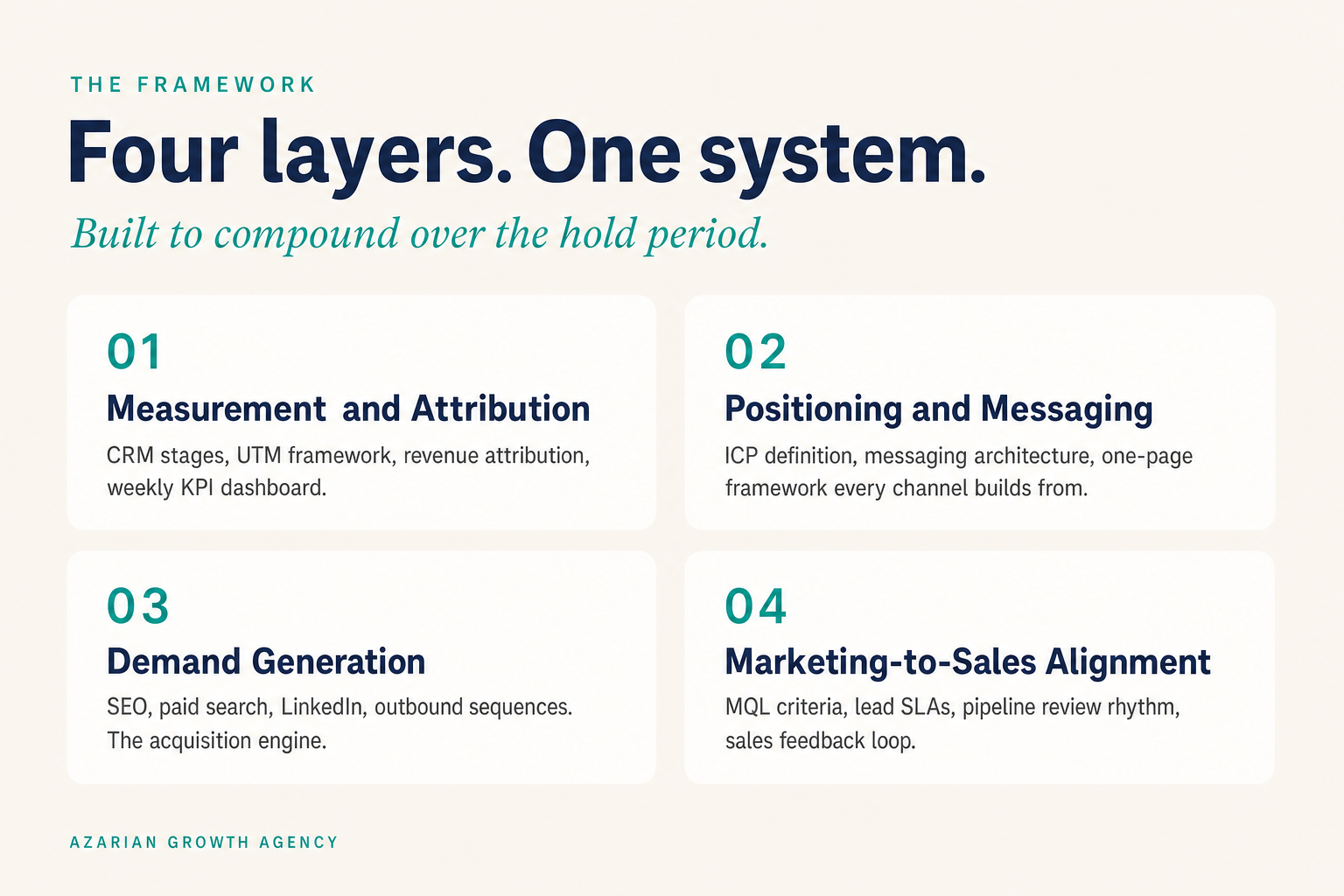
Building marketing infrastructure at a portfolio company isn’t about running campaigns. It’s about building four foundational layers that make campaigns work — and compound over time.
Layer 1: Measurement & Attribution
You cannot manage what you cannot measure. Before spending a dollar on demand generation, establish clean CRM pipeline stages, a UTM attribution framework, an agreed revenue attribution model, and a weekly KPI dashboard covering MQLs, SQLs, conversion rates, and CPL by channel.
For most acquired companies, this layer alone takes 30–45 days to build correctly. Don’t skip it to launch campaigns faster — you’ll spend six months flying blind. If you need a starting point, our guide on bridging the gap between marketing reports and finance-grade unit economics lays out the framework.
What this looks like in practice: We worked with a $22M B2B services company 14 months post-close that had been running Google Ads for a year with no UTM tracking. Within 45 days of standing up attribution, they discovered 40% of ad spend was going to branded terms that would have converted organically. Reallocating that budget to non-brand campaigns generated 3x more SQLs at the same spend level.
Layer 2: Positioning & Messaging Architecture
Positioning is the strategic foundation that every piece of marketing output — ads, website copy, sales decks, email sequences — is built on. A positioning sprint takes 2–3 weeks. The output is a one-page messaging framework that every content piece, campaign, and sales conversation is built from. This starts with a rigorous ICP definition — not a persona deck with stock photos, but a machine-readable profile your entire go-to-market system can execute against.
Layer 3: Demand Generation Infrastructure
- SEO + content program: 3–6 month runway to organic traffic, but builds durable, compounding pipeline not dependent on ad spend
- Paid search (Google Ads): fastest path to qualified pipeline, requires clean attribution to avoid wasting budget
- LinkedIn demand gen: highest CPL short-term, highest quality for enterprise B2B
- Outbound sequence infrastructure: CRM-integrated sequences targeted by ICP tier and account signal
Understanding where growth marketing ends and demand generation begins is critical here — most portfolio companies need both, but the sequencing depends on hold period position and marketing maturity.
Layer 4: Marketing-to-Sales Alignment
The fourth layer is where most portfolio company marketing programs break down — the operational handoff between marketing and sales. This means defined MQL criteria that sales trusts, SLAs on lead follow-up, a weekly pipeline review rhythm, and a feedback loop from sales on lead quality. A solid RevOps framework that unifies sales, marketing, and customer success is the structural fix — not more meetings.
The 100-Day Marketing Playbook
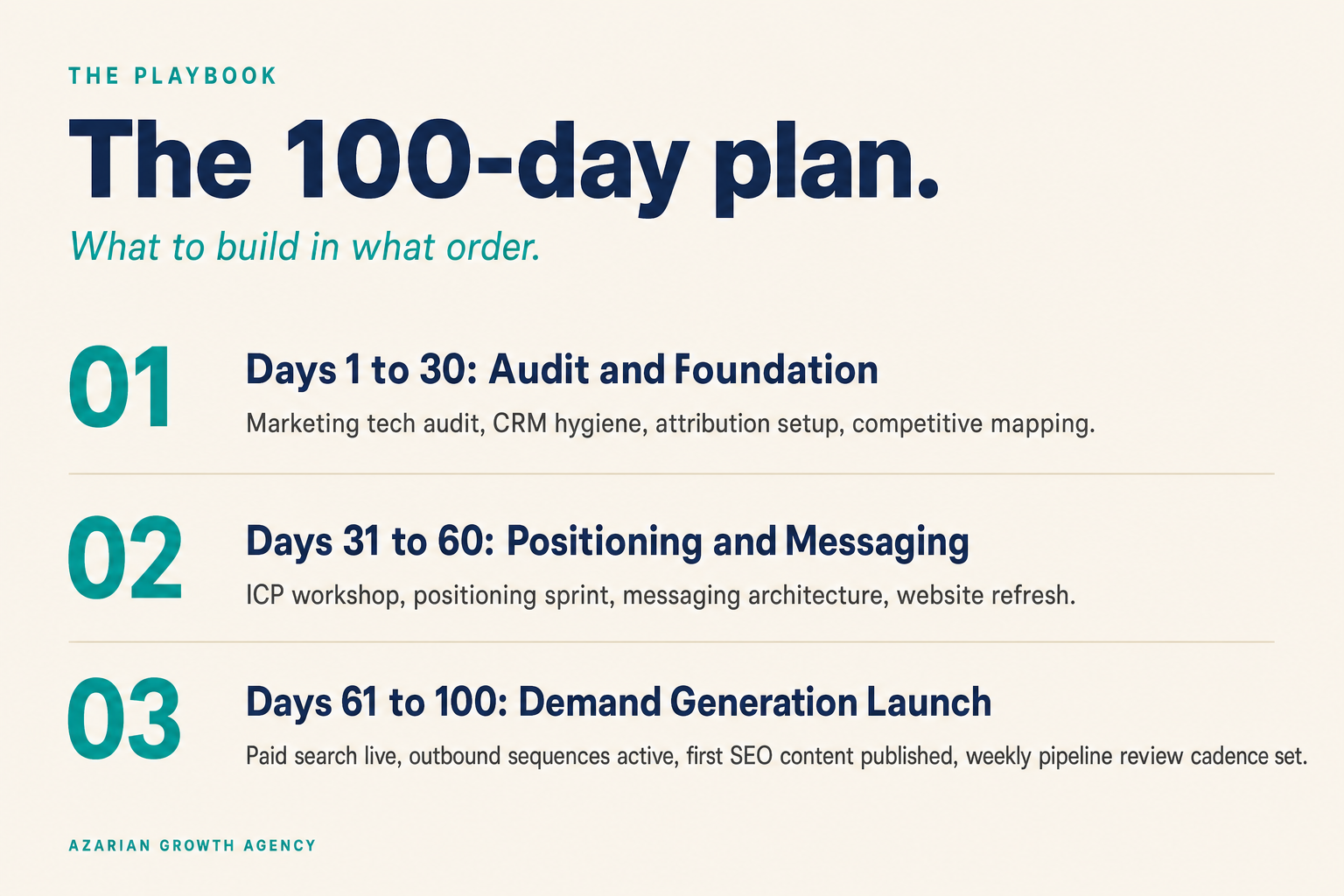
The first 100 days post-close set the tone for the entire hold period. Operating partners that move fastest and most deliberately in this window consistently outperform those who spend the first quarter in assessment mode.
Days 1–30: Audit and Foundation
- Marketing tech stack audit — what’s being used, what’s duplicative, what’s missing. If you want to do this before engaging an outside team, our DIY marketing audit guide walks through the process step by step.
- CRM hygiene sprint — clean pipeline stages, remove dead contacts, build reporting views
- Attribution setup — UTM framework, GA4 configuration, connect CRM to ad platforms
- Current-state content and SEO audit — baseline organic traffic, keyword rankings, content inventory
- Competitive landscape mapping — top 3–5 competitors, how they position, where the gaps are
Days 31–60: Positioning and Messaging
- ICP definition workshop with sales and leadership
- Positioning sprint — problem, proof, category frame, differentiation
- Messaging architecture document — headline, subheadline, value props, objection responses
- Website copy update — minimum viable refresh of homepage, solutions pages, and about page
- Sales deck alignment — update pitch materials to reflect new positioning
Days 61–100: Demand Generation Launch
- Launch paid search campaigns with clean tracking
- Activate outbound sequences — first ICP tier, 3-step sequence minimum
- Publish first 2–4 SEO-targeted blog posts in the primary content pillar
- Establish weekly marketing-to-sales pipeline review cadence
- Set 90-day KPI targets: MQLs, SQLs, pipeline contribution, CPL by channel
By Day 100, you should have a functioning attribution system, a clean CRM, an updated website, active demand generation on at least two channels, and a weekly reporting rhythm. Everything from Day 101 forward is optimization and scaling.
What Good Looks Like: KPI Benchmarks by Milestone
Operating partners need more than a playbook — they need a way to know whether the playbook is working. These are the benchmarks we use to evaluate marketing infrastructure maturity at portfolio companies across the hold period.
| Metric | Day 90 | Day 180 | Day 365 |
|---|---|---|---|
| Attribution coverage | 80%+ of spend tracked to source | 95%+ with multi-touch model live | Full-funnel revenue attribution tied to CRM |
| Marketing-sourced pipeline | First SQLs from paid channels | 20–30% of total pipeline | 40–50% of total pipeline |
| Cost per SQL | Baseline established | 15–25% reduction from baseline | 30–40% reduction from baseline |
| Organic traffic | Content program launched, baseline set | 30–50% traffic growth | 2–3x organic traffic from baseline |
| Lead-to-close velocity | Follow-up SLA established (48hr max) | <24hr avg first-touch response | Marketing + sales on shared weekly pipeline rhythm |
| Website conversion rate | Baseline measured | 2–3% (B2B benchmark) | 3–5% with CRO iteration |
If a portfolio company isn’t hitting these benchmarks within the expected timeframes, the issue is almost always in the layer sequencing — campaigns launched before attribution, or demand gen activated before positioning. Go back to the four layers and diagnose which one is incomplete.
Want this playbook deployed at your portfolio company?
We build marketing infrastructure for PE-backed companies — from Day 1 attribution setup through demand generation launch. Our diagnostic identifies exactly where your portfolio company stands and what to fix first.
Building a Repeatable System Across Multiple Portfolio Companies
The firms that get the most value from portfolio marketing do not reinvent the wheel at every acquisition. They build a repeatable playbook — a standardized set of tools, processes, and frameworks deployable across any portfolio company, regardless of vertical or business model. This is the core thesis behind the PE platform strategy — creating synergies across portfolio companies rather than treating each as an isolated operation.
Standardized Tech Stack
Define a preferred marketing tech stack that every portfolio company migrates to over the first 12 months. Standardization enables faster onboarding at each new acquisition, cross-portfolio CPL benchmarking, and reduced vendor costs through volume relationships.
Shared Playbooks and Templates
Every process built at one portfolio company should be documented and templated for the next: ICP definition template, positioning framework, UTM taxonomy guide, MQL criteria model, marketing-to-sales SLA template, and weekly dashboard template.
Cross-Portfolio Marketing Talent Network
Build a bench of fractional and full-time marketing talent the firm can deploy across portfolio companies — fractional CMOs for early-stage build-outs, demand generation specialists, and content strategists who understand the B2B contexts your portfolio operates in.
Fractional CMO vs. Full Hire: The Right Model for PE Speed
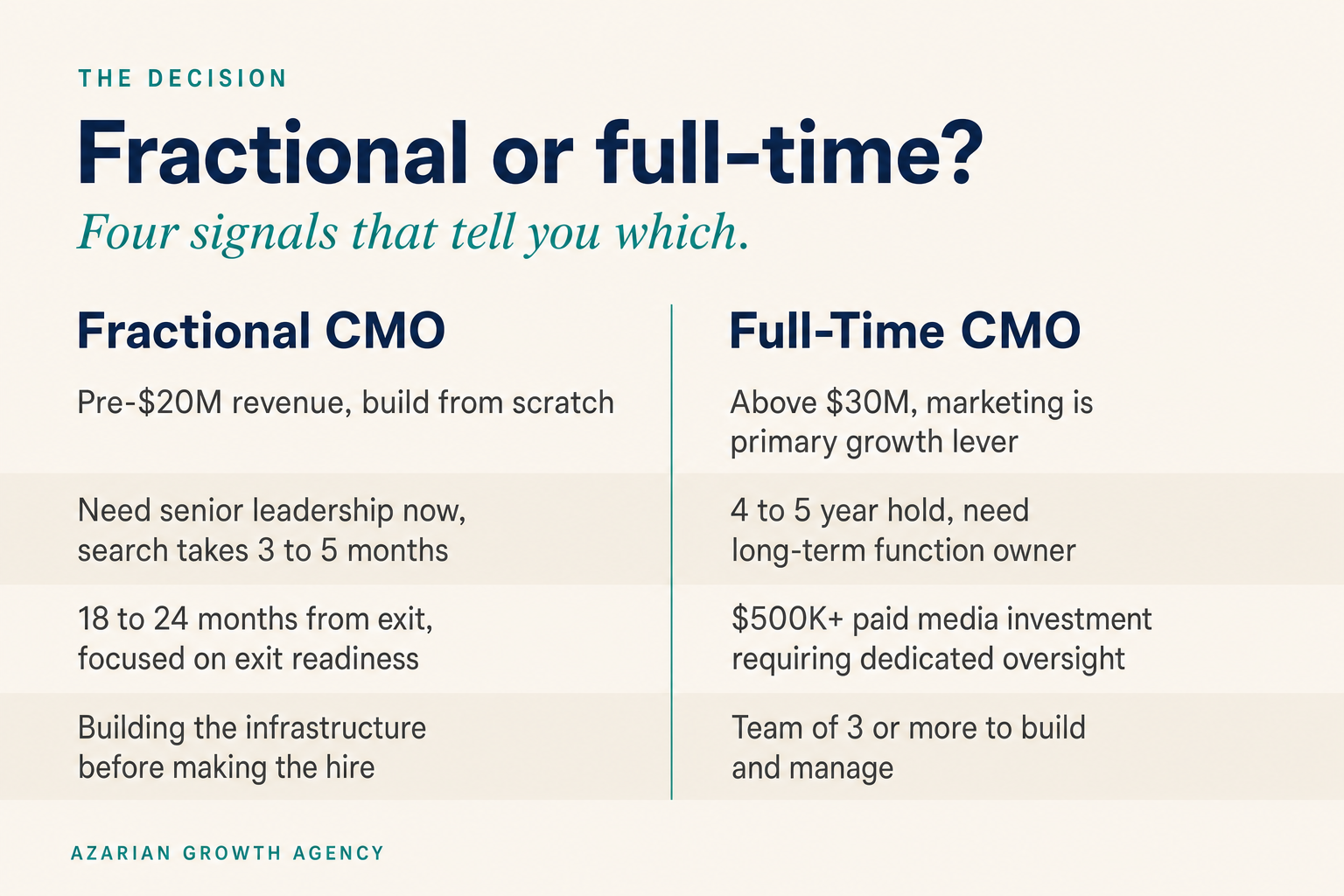
One of the most consequential talent decisions an operating partner makes in the first 60 days is whether to hire a full-time CMO or engage a fractional marketing leader. The answer depends on the company’s marketing maturity, revenue scale, and hold period position.
The data supports a fractional-first approach in most cases. According to Spencer Stuart’s 2025 CMO Tenure Study, the average CMO tenure is just 4.1 years — the shortest in the C-suite — and a typical executive search takes 3 to 6 months from kickoff to accepted offer. That’s a quarter of your hold period spent searching, plus another quarter for onboarding. Meanwhile, 73% of PE firms now recommend fractional executives to portfolio companies, up from 31% in 2020. For a deeper look at this model, see our guides on what a fractional CMO actually does and how fractional CMO-as-a-service works in practice.
When a Fractional CMO Makes Sense
- The company is pre-$20M revenue and doesn’t have the volume to justify a $200K+ full-time hire
- The marketing function needs to be built from scratch in 6–9 months
- The company needs senior strategic leadership immediately and a full-time search will take 3–5 months
- You’re 18–24 months from exit and need a seasoned operator focused on exit readiness
When a Full-Time CMO Is the Right Call
- The company is above $30M revenue and marketing is a primary growth lever in the value creation plan
- The hold period is 4–5 years and you need a leader who will own the function long-term
- The company is making a significant paid media investment ($500K+/year) requiring dedicated oversight
- The CMO role is expected to build and manage a team of 3+ people
A hybrid model many PE-backed companies use successfully: engage a fractional CMO for the first 6–9 months to build the infrastructure, then use that fractional leader to recruit and onboard a full-time CMO who inherits a functioning system rather than a blank page.
Common Mistakes PE Firms Make with Portfolio Marketing
Mistake 1: Treating Marketing as a Month 6 Problem
The most expensive mistake is delay. Every month without attribution is a month of wasted spend you can’t recover. Every month without a positioning refresh is a month where the sales team pitches an outdated value proposition. McKinsey’s research on PE exits shows that 54% of deal value comes from operational value-creation initiatives — and marketing infrastructure is one of the fastest operational levers to pull. Start on Day 1.
Mistake 2: Inheriting the Agency Roster Without Evaluating It
Most acquired companies come with incumbent agencies. The instinct is to leave them in place while you figure out the business. Audit the agency roster in the first 30 days. Evaluate against EBITDA-denominated outcomes, not vanity metrics.
We audited the inherited agency at a PE-backed home services company eight months post-close. The agency had been reporting ROAS on last-click attribution — their “best performing” campaign was retargeting existing customers who would have converted anyway. Actual new customer acquisition cost was 4x what the dashboard showed. The operating partner had been making capital allocation decisions on fiction for two quarters.
Mistake 3: Building Campaigns Before Building Infrastructure
Campaigns built on a broken attribution system produce data you can’t trust. Campaigns built on undefined positioning produce leads that don’t convert. Sequence matters: infrastructure first, campaigns second.
Mistake 4: Treating Each Portfolio Company as a Standalone Marketing Problem
If every acquisition starts from zero — new tech stack evaluation, new agency search, new playbook design — you’re leaving significant efficiency and speed on the table. Build the playbook once. Deploy it repeatedly.
Mistake 5: Ignoring the Marketing-to-Sales Handoff
Marketing infrastructure that doesn’t connect to a functioning sales process doesn’t produce revenue. Fix the handoff — MQL criteria, lead routing, follow-up SLAs, feedback loops — before you scale demand generation spend.
Private equity value creation starts with marketing infrastructure.
We’ve built this system at portfolio companies across B2B services, logistics, SaaS, and professional services. If you’re an operating partner evaluating your portfolio’s marketing maturity, we’ll run a diagnostic and show you exactly where the gaps are — and what fixing them is worth in EBITDA terms.

