

Most private equity software on the market today is not software. It is a data subscription with a dashboard bolted on, a CRM with a PE-themed skin, or a reporting layer that aggregates numbers your finance team already has. The category is crowded because the marginal cost of wrapping existing data sources has never been lower. What is not crowded: tools that actually change how a PE firm sources deals, builds commercial infrastructure inside portfolio companies, or accelerates value creation across a platform strategy.
This distinction matters more now than it did two years ago, because the buy-and-build cycle has tightened, LP expectations on EBITDA delivery have not, and Operating Partners are being asked to do more with the same bandwidth. Buying another wrapper does not solve that problem. It adds another tab to the browser.
This post is a framework for cutting through the noise — identifying which software categories are genuinely differentiated, which are commodity dressed up in SaaS pricing, and what an actual operating system for PE value creation looks like in 2026.
Why Did Private Equity Software Get So Crowded So Fast?
The answer is structural. The raw ingredients for a PE software product are largely commoditized: company financials from Pitchbook or S&P Capital IQ, ownership data from Crunchbase, news and signal aggregation from any number of API providers, and a CRM backbone from Salesforce or HubSpot. The build cost for a minimum-viable “PE platform” using these inputs has fallen to the point where a 3-person team can put something credible-looking in front of a Managing Director within 90 days.
The result: a market with roughly 80–120 vendors all solving variations of the same four problems — deal sourcing, portfolio monitoring, LP reporting, and deal execution workflow. Most of them are pulling from the same upstream data providers. The differentiation is UI, pricing, and go-to-market narrative, not underlying capability.
There is nothing wrong with this in principle. Commoditized workflow tools are genuinely useful — they free up analyst time, reduce manual data entry, and make governance processes more consistent. The problem is when a firm spends $200K annually on tools that are all solving workflow problems while the actual value creation levers — how do you grow revenue inside a portco, how do you build a repeatable GTM engine across a platform, how do you identify the next acquisition target before your competitors — remain unaddressed by anything in the stack. This gap is precisely what a real private equity platform strategy is designed to close.
Presenting at SF & LA Tech Week — October 2026
Hamlet Azarian is running live Growth OS sessions at SF Tech Week (Oct 8) and LA Tech Week (Oct 15) — showing PE Operating Partners exactly how to build commercial infrastructure across a portfolio without adding headcount. Limited seats, active platform strategy firms only.
How Do You Actually Identify a Wrapper?
A wrapper is a product that derives most of its value from data or infrastructure it did not build and cannot differentiate on. The test is simple: if the vendor lost access to its primary data provider, would the product still have any meaningful function? If the answer is no — if the “platform” is essentially a query interface on top of Pitchbook or FactSet — you are buying a subscription to someone else’s data at a 3x markup.
The wrapper test has four diagnostic questions:
- Where does the proprietary data come from? If the answer is a named third-party provider you could access directly, the vendor is a data reseller with a UI layer.
- What does the product do that the underlying data source cannot? Workflow orchestration, AI-assisted analysis, and model outputs built on top of raw data can be genuine value-adds. Pure presentation of the same data is not.
- Is there a network effect? Products that get smarter as more firms use them — because they train on interaction data, aggregate proprietary signals, or surface patterns across a user base — have a genuine moat. Wrappers do not improve with scale.
- Can you get a reference from a firm that uses it for value creation, not just reporting? Reporting tools are purchased by CFOs. Value creation tools are purchased by Operating Partners. Ask which conversation this is.
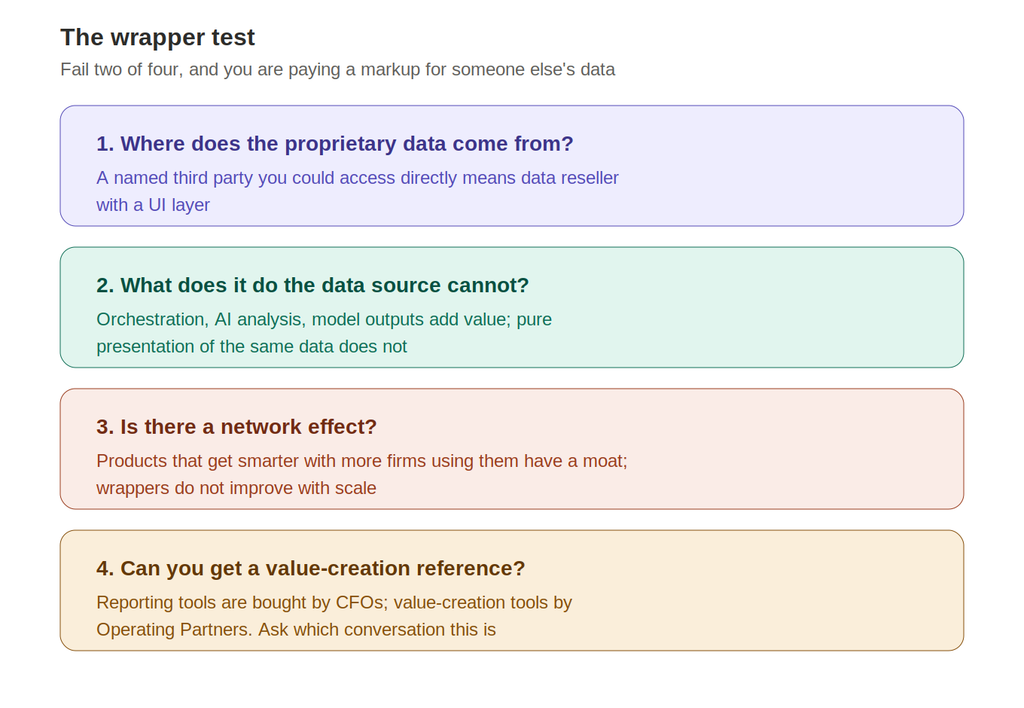
Most PE software fails at least two of these four. That does not make it worthless — a well-designed reporting tool that saves 20 hours per quarter per portfolio company is a real return on the license fee. But it is not a strategic capability. It is operational hygiene. For a deeper look at what separates monitoring from execution, see the Operating Partner’s playbook on portfolio marketing.
Which Categories in PE Software Are Actually Worth Paying For?
After three years of working directly inside PE portfolio companies and with Operating Partners running platform strategies, we have developed a clear taxonomy of what creates real leverage versus what creates the illusion of capability.
Genuinely Differentiated
Proprietary deal origination networks. A handful of firms have built deal flow that does not rely on the same sell-side banker distribution everyone else uses — sourcing directly from founder communities, industry associations, or operating company networks. These are not software products in the traditional sense, but the firms that have built them have durable sourcing advantages that commodity platforms cannot replicate.
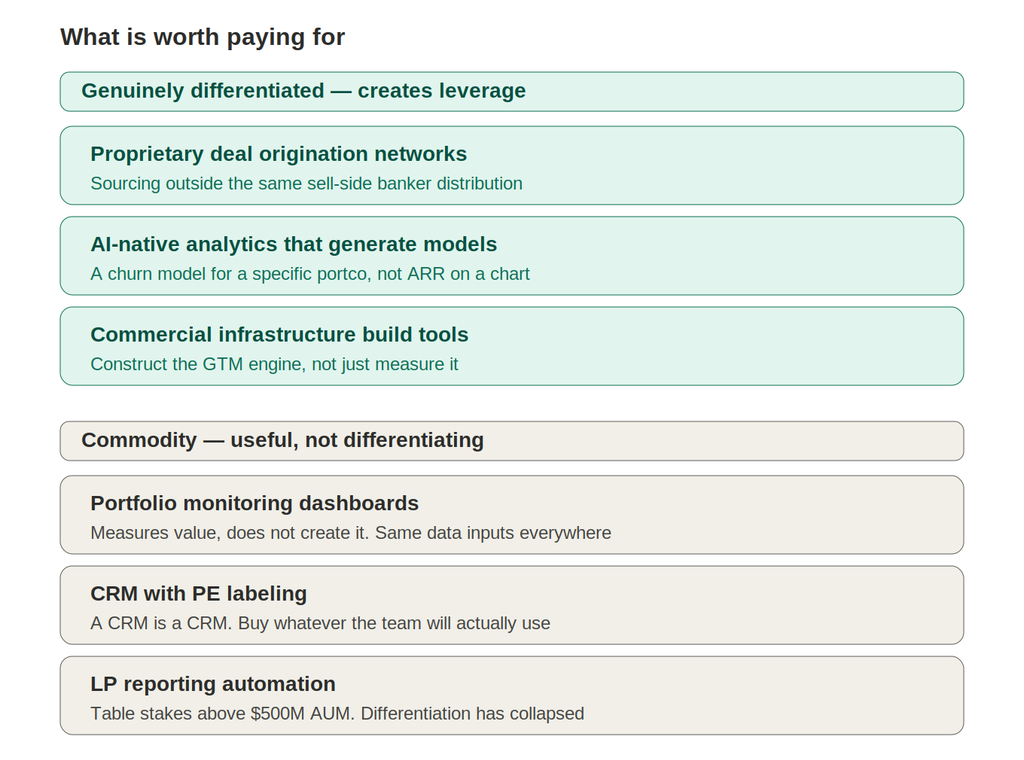
AI-native portfolio analytics that generate models, not dashboards. The distinction is outputs: a tool that generates a churn prediction model for a specific SaaS portco based on its cohort data is categorically different from a tool that displays that portco’s ARR on a chart. The former requires real ML infrastructure and domain-specific feature engineering. The latter is a BI tool.
Commercial infrastructure build tools. This is the most underdeveloped category in the market. Most portcos that come out of a PE acquisition have founder-led sales, no documented GTM playbook, no content or SEO presence, and no demand generation engine. The tools that help Operating Partners build that infrastructure — not just measure it, but actually construct it — are rare. The relevant question for any portco is not “what is our organic traffic” but “how do we build the organic traffic engine this portco has never had.” Understanding how leading PE firms drive expansion beyond M&A is a useful frame here.
Commodity — Useful, Not Differentiating
Portfolio monitoring dashboards. Useful for board prep. Does not create value — it measures it. Every major provider in this space is pulling from the same financial data inputs. The UI varies. The underlying information does not.
CRM systems with PE labeling. A CRM is a CRM. The fact that it has “deal pipeline” language instead of “sales pipeline” language does not change the fundamental utility. Buy whatever CRM the team will actually use.
LP reporting automation. Table stakes for any fund above $500M AUM. The tools in this category are mature and competitively priced. Differentiation at the product level has largely collapsed.
What Does a Real PE Operating System Look Like?
The framing of “software” is part of the problem. The most useful tools for PE value creation are not discrete software products — they are operating systems that span deal sourcing, portfolio company execution, and exit preparation as a continuous, connected workflow.
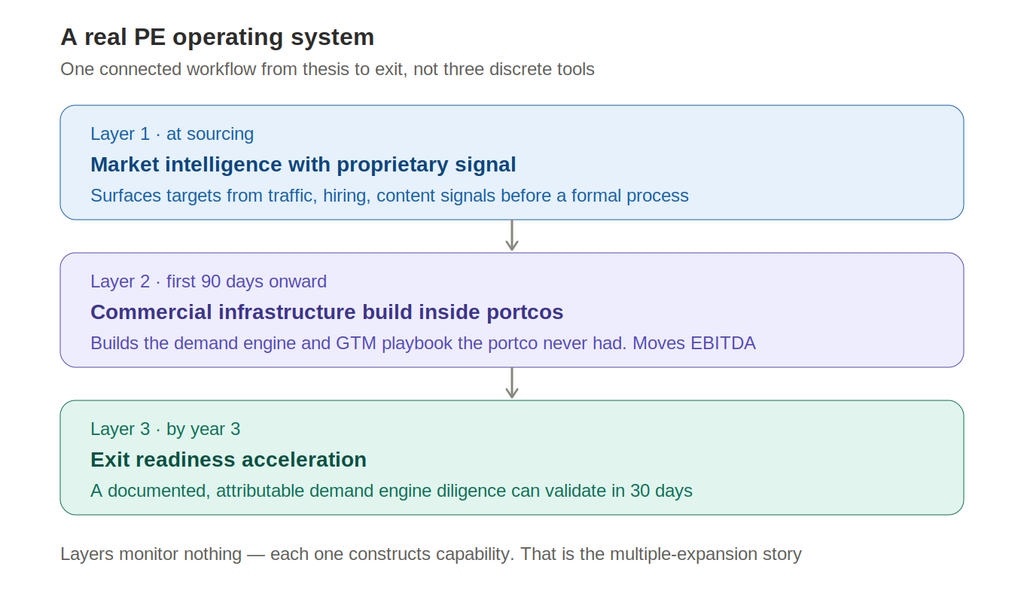
An operating system for PE value creation has three functional layers:
Layer 1 — Market intelligence with proprietary signal. Not just “here are the companies in this sector.” The system surfaces acquisition targets based on a firm’s specific platform thesis: the product category, the revenue range, the geographic footprint, the customer concentration profile. It uses signals that a sector banker does not have — web traffic trajectories, hiring patterns, content investment as a proxy for growth intent — to identify targets before they are in a formal process. This requires proprietary data processing, not a Pitchbook subscription.
Layer 2 — Commercial infrastructure build inside portcos. After acquisition, the gap between investment thesis and operating reality becomes visible within 90 days. Revenue assumptions were built on management representations. The actual GTM engine is a founder with a Rolodex. An operating system closes that gap not by reporting on it — by building the organic demand engine, the content infrastructure, the paid acquisition playbook, and the account-based outreach system that the portco never built while it was growing on referrals. The most effective approach mirrors what works in autonomous GTM systems built for B2B growth — replacing manual commercial build with a systematized, agent-driven process. This is the work that moves EBITDA. Monitoring tools do not touch it.
Layer 3 — Exit readiness acceleration. By year 3, the operating system should have created a documented, repeatable, scalable commercial engine that a buyer’s due diligence team can validate in 30 days. Not because the portco “has marketing” — but because it has a demonstrable, systematized demand generation capability with trackable attribution from spend to revenue. That is a multiple expansion story, not a dashboard.
If you’re running a platform strategy, this is what we build.
Growth OS is built for Operating Partners who need to construct commercial infrastructure across multiple portfolio companies simultaneously — without proportional headcount growth. We’re running live working sessions at SF Tech Week (October 8) and LA Tech Week (October 15) for PE firms actively building on this problem. If that’s you, come see it in action.
What Is the Right Framework for Evaluating PE Software?
Given the crowded market and the prevalence of wrappers, how should an Operating Partner or Platform Head actually evaluate software for the stack? The framework is straightforward: evaluate on leverage, not features.
Leverage means: does this tool multiply the output of the humans using it, or does it add a new interface layer they have to manage? A tool that generates a first draft of a portco’s 12-month content strategy in 4 hours — instead of the 3-week consulting engagement it would otherwise require — creates leverage. A tool that displays that portco’s web traffic on a cleaner chart does not. The specific growth marketing tactics that move revenue are a useful benchmark for what “leverage” looks like in practice.
Four evaluation criteria that map to this:
- Bandwidth multiplier: Does this tool allow one Operating Partner to do the work that would otherwise require three? If not, it is overhead, not leverage.
- Speed to impact: Does the tool produce something actionable in the first 30 days, or does it require a 90-day implementation before it has any output? Value creation timelines in PE do not accommodate slow software.
- Cross-portfolio applicability: Can the same system create value across multiple portcos simultaneously, or does each installation require full reconfiguration? At 5 portcos, the difference between these two answers is the difference between leverage and work.
- Output measurability: Can you tie the tool’s output to a financial outcome — revenue, CAC, EBITDA contribution — within 6 months? If the only metric is usage, the tool is a cost center.
Most software that fails these criteria is not bad software. It is software solving the wrong problem. It optimizes a workflow that is not the constraint. The constraint, in almost every mid-market portco, is commercial execution — building a real demand engine where the founder’s relationships used to be. That is where the tool evaluation should focus. The practical playbook for growth marketing inside PE portfolio companies covers the commercial build side in detail.
What Does This Mean for Operating Partners Right Now?
The software consolidation wave is coming. The wrapper category will get compressed as the underlying data providers build their own UI layers and as AI-native tools eliminate the workflow efficiency argument that made wrapper products defensible in 2022–2024. Operating Partners who have built their playbook around a stack of commodity tools are going to find that stack less useful — and more expensive relative to alternatives — within 18 months.
The firms that will be in the best position are the ones that have already made the shift from monitoring-oriented software to execution-oriented infrastructure. The test: open your current software stack and ask which of those tools is actively building commercial capability inside your portcos — not measuring it, not reporting it, but constructing it. If the answer is none, that is the gap. It is the gap that Growth OS was built to close.
The platform/add-on strategy has never been more operationally demanding. More acquisitions per fund, tighter hold periods, and LPs that have seen what AI-native operating partners can do mean that “we have a good VCP and a dashboard” is not a defensible position in 2026. The firms compounding at the top of the quartile rankings are not buying better wrappers. They are building operating systems. And building one starts with understanding what an autonomous growth pipeline looks like end-to-end. The AGA private equity practice exists to build exactly that — for firms that are ready to stop monitoring and start constructing.

