

What Happens After the Agent Finds Your Lead: The Human-Agent Handoff Playbook
I had a conversation with a Series B founder, maybe nine months ago, that has stuck with me. He had read the right things, attended the right webinars, and made what looked like a smart decision. He was going to build the agent infrastructure himself. He had a sharp RevOps lead, a couple of engineers who could write prompts, and a willingness to invest. He told me confidently that the agency model was outdated and that any company that took agents seriously would build them in-house.
Six months later, he called and asked if we could help. Not because the build had failed, exactly. Because the build had succeeded at producing something his team could not maintain. The agents worked. The orchestration was fragile. The RevOps lead who built the system was burned out and threatening to quit. The engineers had moved on to product work. And every time the founder wanted to change the ICP definition or add a new signal source, the conversation turned into a small project that nobody wanted to own.
He had built the right architecture. He had not built the right operating model around it. And the gap between those two things is what most build-versus-partner conversations get wrong.
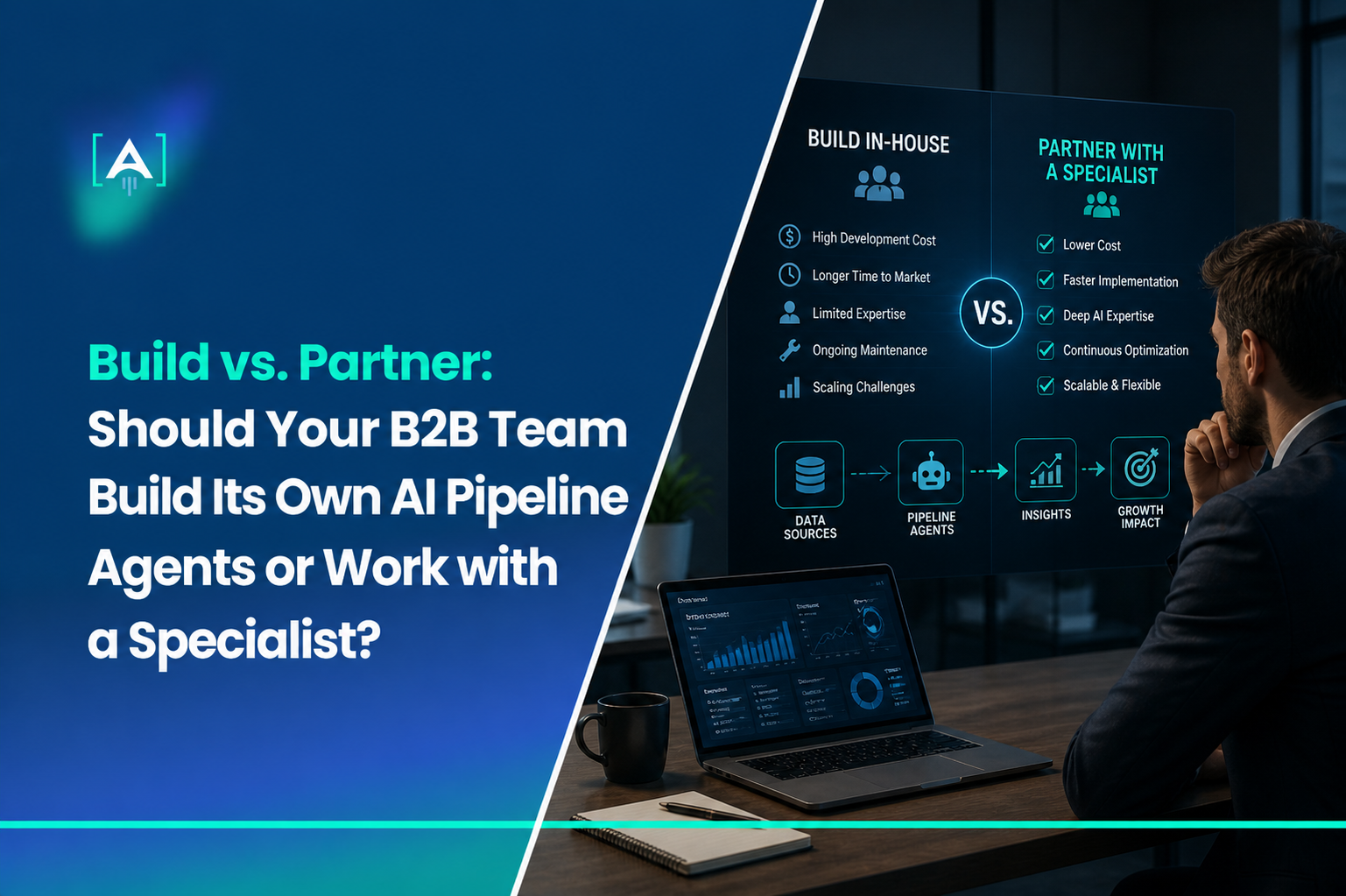
Most teams frame this decision as build versus buy. Buy a packaged AI SDR product, or build your own from scratch. We have written separately about why packaged AI SDR tools and autonomous agent systems are different categories. The buy path is real, and for some companies, it is the right answer. But the more interesting question, the one that comes up at every diagnostic I run with PE-backed and growth-stage B2B companies in 2026, is build versus partner. Should we stand up the agent stack ourselves with internal capacity, or work with a specialist who builds and operates it to our spec?
The honest answer depends on five conditions. Most teams answer incorrectly because they have not thought about all five.
See the full agent system run live: the autonomous agents pipeline demo at Tech Week Boston.
The third option most teams miss
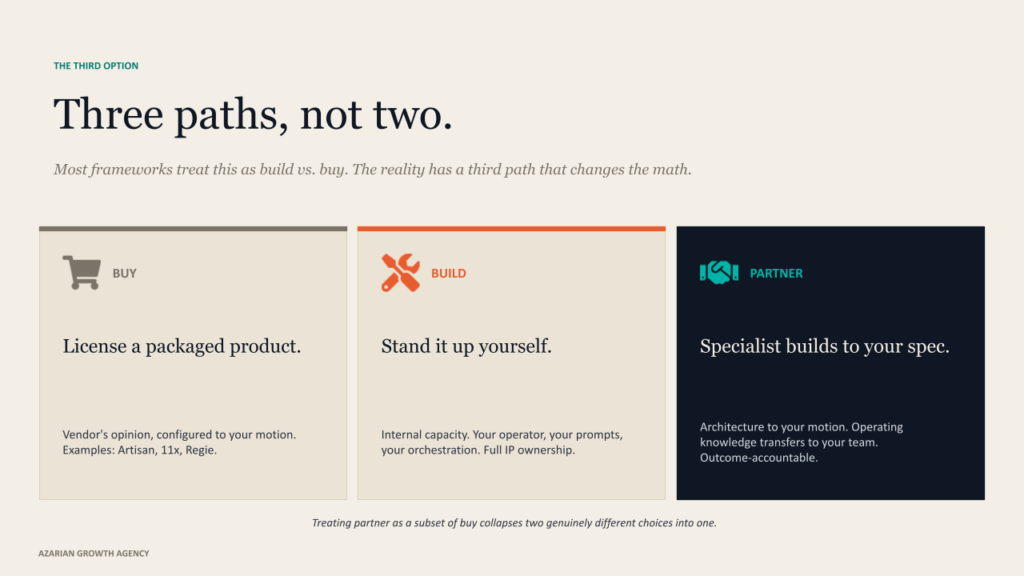
The standard build-versus-buy framing is borrowed from enterprise software decisions of the last fifteen years. Should we license a CRM or build one? Should we use a marketing automation platform or build internal tools? The frameworks for those decisions have been written extensively. MIT Sloan’s framing of buy, boost, or build for generative AI and Insight Partners’ work on the same question are two of the better recent treatments. Both are useful. Both are also incomplete for the agent infrastructure decision because they treat the choice as binary.
The reality on the ground in B2B GTM is that there are three paths, not two. Buy a packaged product. Build it yourself. Partner with a specialist. Each path has different unit economics, different risk profiles, different team requirements, and different long-term implications for ownership of the system. Treating a partner as a subset of buy collapses two genuinely different choices into one and produces decisions that look reasonable on paper and break in execution.
The buy path is well understood. You pick a vendor like Artisan or 11x, configure it to your motion, and accept the vendor’s opinion about how outbound should look. The packaged tool is excellent at outsourcing commodity work and is limited in handling motion-specific complexity. The build path means standing up the infrastructure yourself with your own people. The partner path means working with a specialist who builds the architecture to your spec, hands you the prompts and the workflows, and operates the system with you over time.
The frameworks that say build versus buy are not wrong. They are just answering a different question than the one growth-stage operators are actually asking.
What building it yourself actually requires
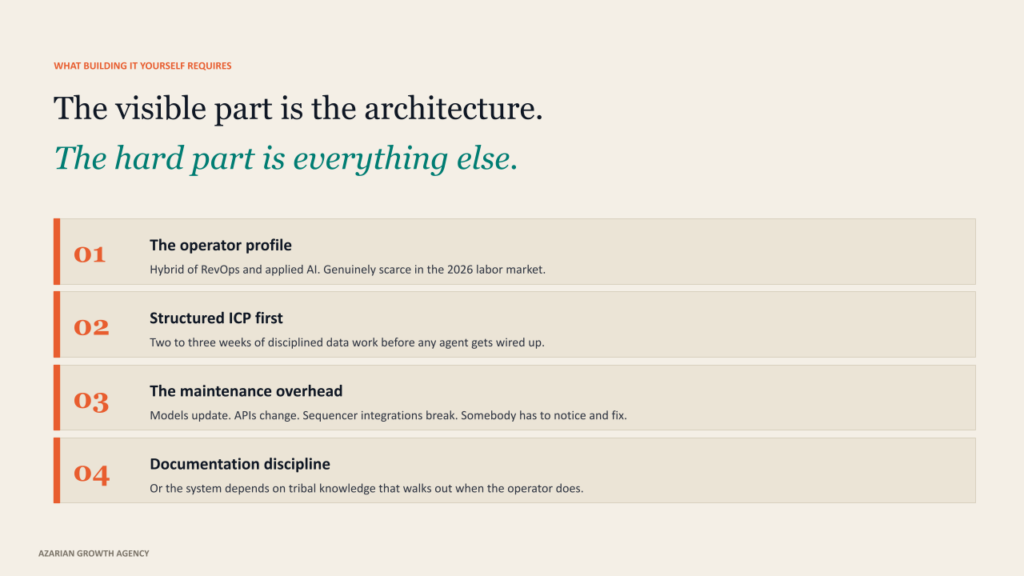
I am going to be honest about what the build path looks like because the founders who chose it and regretted it almost always tell me the same thing. They underpriced the operating model.
The architecture itself, the agents, and the orchestration are the visible parts. We have written elsewhere about the autonomous GTM playbook, and the shape of the agent chain is consistent across implementations. Claude Code for the orchestration logic, n8n or a similar runtime for the wiring, Clay for waterfall enrichment, UserGems, and Common Room for relational and intent signals. The pieces are real, and the patterns are knowable.
The hard part is everything else. The build requires a person who can think in agent terms, write prompts that hold up under load, debug LLM outputs when they drift, and translate between business logic and agent behavior. That person is rare. 6sense’s 2026 State of BDR Report makes the point that the operators producing serious agent results are not generic engineers or generic RevOps leads. They are a specific hybrid that most companies do not have on staff and would have to recruit, retain, and pay competitively against AI-native startups.
The build also requires a structured ICP and a signal architecture before any agent gets wired up. We have written about how to define an ICP for an autonomous pipeline system separately, and the work is real. Two to three weeks of disciplined data work, AE interviews, closed-won pattern analysis, and structured documentation. Skip this step, and the agent runs the wrong work faster than a human team would.
Then there is the maintenance overhead nobody prices. Models update. Data sources change their APIs. Apollo and UserGems ship product changes that quietly break enrichment workflows. Sequencer integrations like Outreach or Salesloft update their API schemas. The agent system you stood up six months ago is producing different outputs today, and somebody has to notice and fix it. If that somebody is also responsible for two other functions, the system slowly degrades.
The honest version of the build cost is the architecture build itself, plus the ongoing operating cost of the team that maintains it, plus the opportunity cost of taking your sharpest revops or engineering operator off whatever they were working on before. The first number is the only one most teams quantify when they make the build decision.
The build path is rarely cheaper than the partner path. It is just easier to budget incorrectly.
What partnering with a specialist actually means
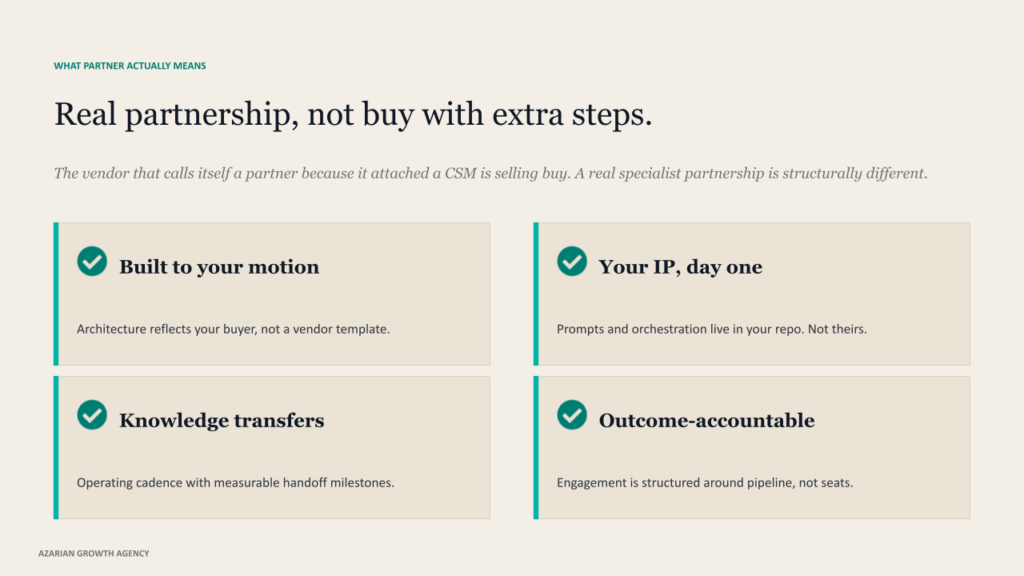
There is a version of the partner conversation that is just the buy conversation in disguise. The vendor sells you their product, attaches a customer success manager, and calls the relationship a partnership. That is not what I mean here. The partner path I am describing is structurally different.
A real specialist partnership in this category looks like this. The specialist builds the agent architecture to your motion, not to a vendor template. The IP lives in your prompts and your orchestration, not in their product. The specialist transfers the operational knowledge over time so your team can take over more of the work as your in-house capacity matures. The relationship is structured around outcomes, not seats. And the specialist is accountable for the system’s performance, not just for the implementation.
What the specialist brings is the thing that takes the longest to build internally. Operating reps. The patterns that work and do not work across dozens of motion shapes, the failure modes that emerge in production, the prompt strategies that hold up under signal noise, the orchestration patterns that survive when one of the data sources goes down. Marty Cagan’s piece on build vs. buy in the age of AI makes the related point that AI-era decisions are less about the technology itself and more about which team has done the cycles of operating it under real conditions.
The specialist also brings architectural opinions, which are either a feature or a bug depending on whether your team has its own. If your RevOps lead has a strong point of view on what good signal architecture looks like, the specialist works inside that. If your team is starting from a blank page, the specialist’s prior reps become the starting opinion you adapt from. Either way, you are paying for compounded judgment, not just labor.
The partner path is not free of risk. The specialist could be bad at their work. The handoff to your team could be poorly structured. The relationship could end up as buy-with-extra-steps if the specialist is more interested in selling seats than transferring operating knowledge. These are real failure modes. The way to avoid them is in how the engagement is structured up front, which is its own conversation.
Five conditions that decide which path fits
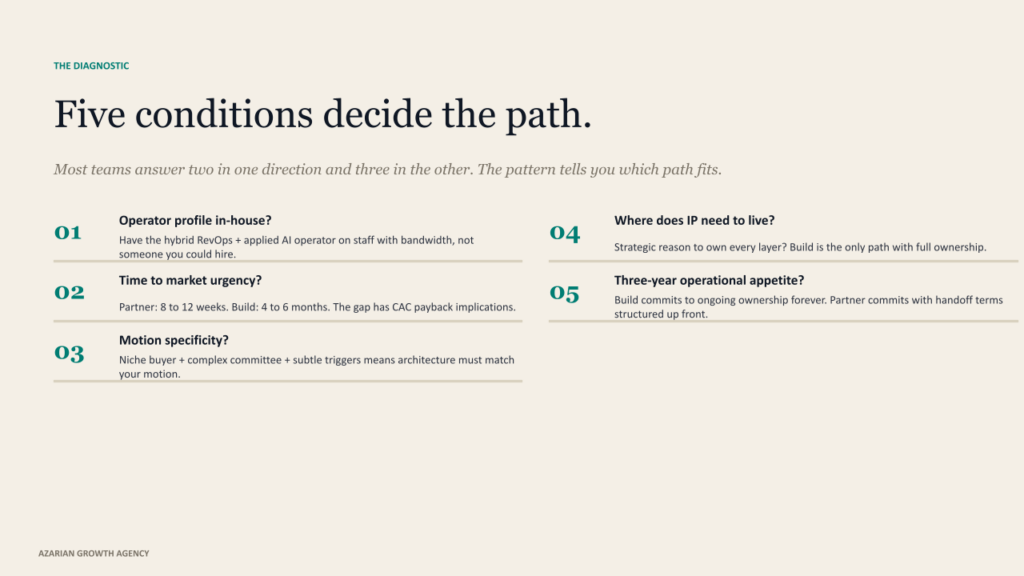
When a client asks me which path is right for them, I do not start with cost. I start with five conditions about their team, their motion, and their time horizon. The answers usually settle the question.
Do you have the operator profile in-house already? Not someone you could hire, someone you have. The agent operator is a hybrid of RevOps and applied AI, and the hire is genuinely scarce. If the person is on staff and has bandwidth, build is in reach. If you had to recruit them in a market where AI-native startups are paying premium comp, the partner path is faster and cheaper for the first 12 to 18 months.
How fast do you need to be in the market? A specialist partner can have a structured ICP, a signal architecture, and the first agent producing pipeline in 8 to 12 weeks. An internal build, even with the right operator, runs 4 to 6 months from kickoff to first reliable output. The time difference is real, and it has CAC payback implications.
How specific is your motion? If your buyer is technical, your sales cycle is long, and the trigger events that matter are subtle, you need an architecture built to your motion specifically. Both the build and the partner can do this. Buy cannot. The decision between build and partner here is about who has more pattern recognition for motions like yours, your team, or the specialist’s.
Where does the IP need to live? Some companies have a strategic reason to own every layer of their GTM motion. The agent prompts, the orchestration logic, the signal weighting, the verification gates. If your defensibility model depends on this, the build path is the only path that gives you full ownership. The partner path can give you most of it through proper handoff structure, but not all of it.
What is your three-year operational appetite? The agent system is not a one-time build. It is a living artifact that needs to be maintained, recalibrated, and evolved as your motion changes. Building means committing to that operational responsibility forever. Partnering means committing to it for as long as the partnership lasts, with handoff terms structured up front. If your team’s appetite for ongoing system ownership is high, build wins. If it is uncertain, partner wins.
Most teams answer two of these in favor of build and three in favor of partner, or the reverse. The pattern that surfaces tells you which path fits.
What Happens After the Agent Finds Your Lead: The Human-Agent Handoff Playbook
The cost comparison nobody runs
Here is the part that surprises most operators when we work through it together. The per-month sticker price comparison favors the build path. The 18-month all-in cost comparison usually does not, and the reason is the line items that do not show up in the build budget.
The build path on a per-month basis looks like the salary of the operator plus the tool stack. Maybe $25K to $35K a month all-in for a senior person, plus the agent infrastructure. The partner path looks more expensive on the surface, somewhere in the $15K to $40K a month range, depending on scope and scale, sometimes higher for larger deployments. On a sticker comparison, the build looks cheaper.
The line items that change the comparison over 18 months are the architecture buildout cost (which is concentrated in months one through four for build, embedded in the partner cost), the maintenance overhead (which compounds for build, included for partner), the opportunity cost of the operator’s other work (real for build, zero for partner), the ramp time before the system produces reliable pipeline (longer for build, shorter for partner), and the risk of operator departure (real for build, mitigated for partner because the specialist has bench depth).
When you actually run the 18-month all-in cost on both paths, the partner path comes in lower for most growth-stage and PE-backed companies, sometimes meaningfully so. The exceptions are the companies whose strategic position justifies absorbing the higher cost in exchange for full IP ownership, which is a smaller set than most teams initially think it is.
The hidden risk on the build path
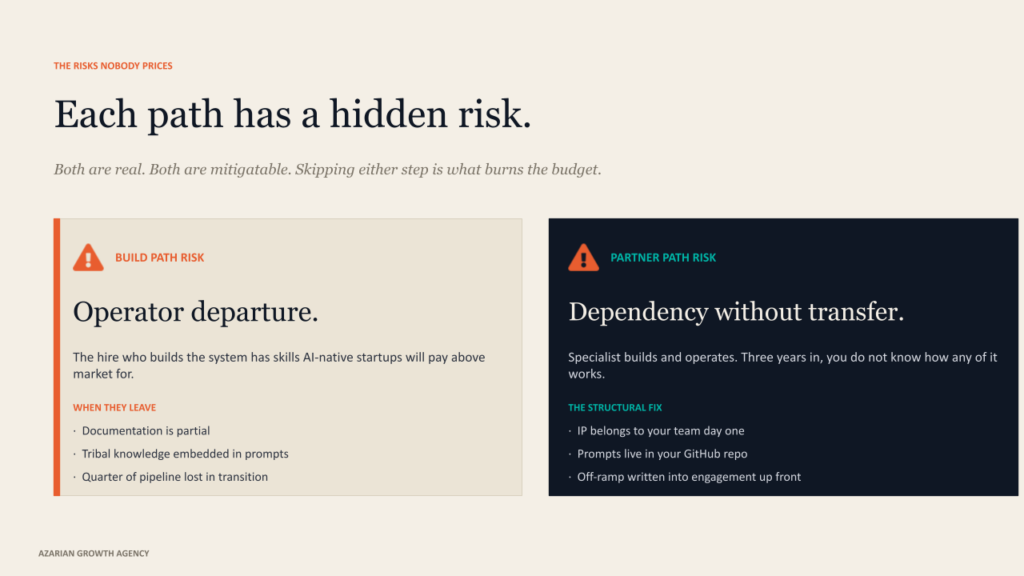
The risk on the build path that almost nobody prices into the decision is operator departure. The hire who builds your agent system has skills that AI-native startups will pay above market for, and the labor market for that profile is the tightest it has been in a decade.
When the operator leaves, and they will eventually, you are left with an architecture that only one person on the team understands. The documentation is partial because the operator was busy building, not writing. The prompts are full of opinions that made sense in context but are not legible to the next person. The orchestration logic has tribal knowledge embedded in it. The next operator either has to spend three months reverse-engineering the system or rebuild it from scratch, and either path costs you a quarter of the pipeline.
I have watched this play out at three companies in the last 12 months. In each case, the founder believed the build was a one-time investment that would produce a durable internal capability. In each case, the system depended on a single person who eventually moved on, and the company ended up rebuilding twice or migrating to a partner anyway. The cost of the failed build was not the build itself. It was the lost pipeline during the transition.
This risk is mitigatable. Strong documentation discipline, redundant operator coverage, structured handoff protocols. But mitigating it costs almost as much as not having the risk in the first place, which is the trade-off the partner path makes explicitly.
The hidden risk on the partner path
Fairness requires me to name the risk on the partner path with the same honesty. The risk on the partner path is dependency without transfer. You hire a specialist, the specialist builds and operates the system, the system produces a pipeline, and three years in, you realize you do not know how any of it works.
If the specialist is a good one, this is not a problem because they have been transferring operating knowledge to your team the whole time. The prompts live in your repo. The orchestration logic is documented. Your RevOps lead can adjust the weighting on a signal without filing a ticket. The relationship is a true partnership, and the IP is yours when you want it.
If the specialist is a bad one, you have built the same dependency you would have had with a packaged vendor, but at agency rates. The prompts live on the specialist’s machines. Changes go through a long ticket queue. The motion is theirs operationally, even though it is yours strategically. This is the failure mode that gives the partner path a bad reputation in some quarters, and it is real.
The way to avoid it is to write the transfer terms into the engagement up front. The IP belongs to your team from day one. The prompts and orchestration logic live in your GitHub repository, not theirs. The specialist commits to a knowledge transfer cadence with measurable handoff milestones. Your team takes over a defined percentage of the operational work each quarter. The partnership has an off-ramp that does not strand you. None of this is unusual to ask for. Specialists who refuse to structure the engagement this way are telling you something about the relationship they actually want.
The hybrid that works for most companies
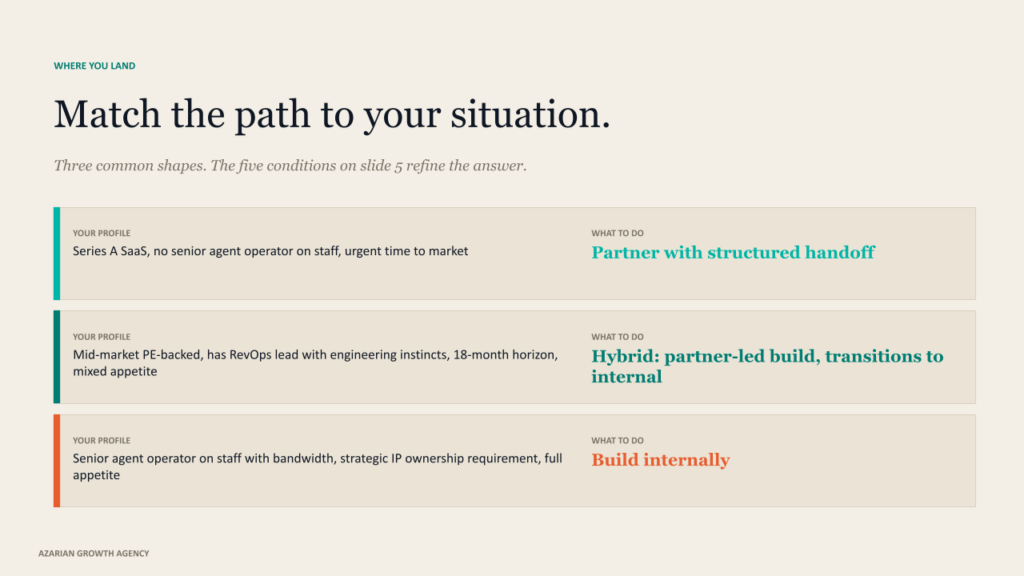
After running the diagnostic with maybe forty companies in this category over the last 18 months, I can tell you what we actually deploy more than any other shape. The pure build is rare. The pure buy is rare. The pure partner with full outsourcing is also rare. The middle path that fits most companies is a structured partnership that transitions over time.
The pattern looks like this. The specialist builds the architecture in the first quarter. The structured ICP, the signal architecture, the decision maker mapping layer, and the agent orchestration that connects them. Your team participates in the build, watches the prompts get written, and learns the patterns. The specialist operates the system in the first six months while your in-house capacity matures. By month nine, your operator is running the day-to-day with specialist oversight on the harder problems. By months twelve to eighteen, the system is fully internal with the specialist on retainer for architecture-level work.
This is not the cheapest path on a per-month sticker basis, especially in the first six months. It is the lowest-risk path on an 18-month all-in basis for most companies. It produces a working system fast, transfers ownership steadily, and avoids the dependency trap on either side.
The companies that get this wrong are usually the ones that wanted to optimize for cheapest in month one and ended up spending more in month twelve to fix what cheapest broke. The GTM stack we run with Claude Code and the operating patterns we have published are designed to make this transition explicit, so the partnership is structured for handoff from day one.
The honest answer
If you have a senior agent operator on staff, an 18-month time horizon, full architectural opinions, and a strategic reason to own every layer of the system, build it yourself. The path is real, and it works for the small set of companies that fit the profile.
If you do not have that profile, and most growth-stage and PE-backed B2B companies do not, the partner path with a structured handoff plan produces a better pipeline at a lower 18-month cost than the build path you would actually execute. The honest version of the recommendation depends on which company you actually are, not which one you would like to be.
The decision is not philosophical. It is operational. Run the five conditions, run the 18-month all-in cost on both paths, and let the answer be what the math says it is. The companies that win this cycle are not the ones with the strongest opinions about build versus partner. They are the ones who matched the path to their actual situation and executed cleanly. Both paths produce good outcomes when the match is right. Both produce expensive lessons when it is not.
About Azarian Growth Agency
Azarian Growth Agency is an AI native growth marketing agency working with VC-backed founders, PE operating partners, and growth-stage B2B leadership teams. We build full funnel growth systems anchored on agent infrastructure, with 91 agents in production across client engagements as of 2026. Our work spans pipeline diagnostics, ICP architecture, decision maker mapping, intent signal infrastructure, and the broader stack of AI content marketing, AI-driven customer insights, and generative AI for marketing.
The Strategic Growth Diagnostic is the entry point for most engagements: a structured assessment of pipeline, CAC, signal infrastructure, and agent readiness, framed against the metrics PE and VC institutional buyers actually use.
Watch the live demo: Tech Week Boston autonomous agents pipeline session.

