

Most DTC brands using AI tools are not running AI-operated businesses. An AI tool waits for a prompt. An autonomous agent owns a workflow. That distinction — what I call the Autonomy Line — separates brands that are using AI to work faster from brands that are using AI to work without human initiation. If you are spending $10M to $100M in revenue and wondering why your AI investment is not compounding, this framework shows you exactly where you stand and what crossing the Autonomy Line actually requires.
The Agentic Operating Model is a six-tier framework I developed at Azarian Growth Agency to help e-commerce operators benchmark their real AI maturity — not their tool stack, their actual operational tier. Most brands discover they are two tiers below where they thought they were. This post explains every tier, maps the Autonomy Line across eight core e-commerce functions, and gives you three diagnostic questions to find your tier right now.
What Is the Actual Difference Between AI Tools and Autonomous Agents?
This distinction matters more than any specific platform or software purchase.
An AI tool is reactive. It produces output when a human asks for it. You open ChatGPT, write a prompt, get a result, review it, and do something with it. Every cycle requires human initiation. The tool has no awareness of your business, no access to your data unless you paste it in, and no ability to act on its own output. It is a very capable assistant that does nothing until you show up.
An autonomous agent is proactive. It monitors a condition, makes a decision, executes an action, and loops back — all without being asked. An agent might watch your revenue dashboard for a drop in repeat purchase rate, identify the segment that churned, write and queue a win-back email campaign, and flag it for your approval — without you ever opening a browser.
The clearest illustration of this gap is a retention email. At the tool level: a marketer notices declining LTV in a segment, writes a brief, pastes it into an AI tool, edits the draft, schedules the send. At the agent level: the agent detects the revenue gap in real time, segments the audience autonomously, generates the email copy, adds it to the send queue, and surfaces it for a single approval click. Same output. Radically different operational load.
This is what separates the two. Not sophistication. Not which company built the model. The question is: who initiates the work?
The Agentic Operating Model: 6 Tiers from Manual to Summit
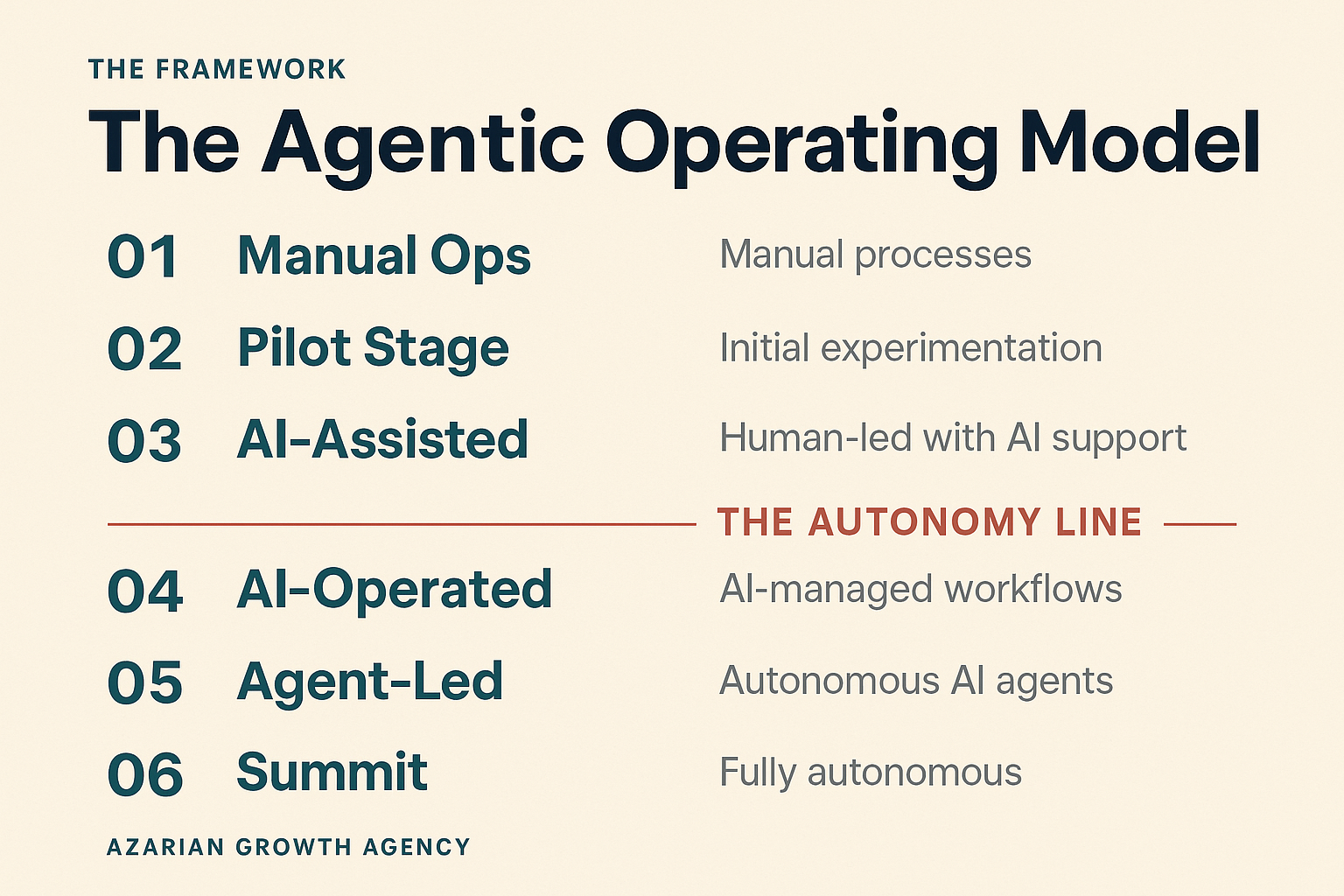
The Agentic Operating Model, developed by Hamlet Azarian at Azarian Growth Agency, maps six tiers of AI operational maturity. Each tier reflects a different relationship between human labor and autonomous systems — specifically, who initiates work, who executes it, and who governs the output.
The tiers are not about which AI tools you subscribe to. A CEO running Claude every morning does not make their company Tier 3. Your tier is determined by how many workflows in the business run without human initiation — not how often individuals use AI in their own work.
Tier 1 (L0) — Manual Ops
Humans execute everything. No AI in the workflow loop. Output multiplier: 1x. Roughly 5–10% of companies still operate here. If this sounds like no one you know, look at your fulfillment operations, your vendor communication, your inventory reorder process. Manual ops do not disappear just because the marketing team uses Canva AI.
Tier 2 (L1) — Pilot Stage
AI as copilot. Individuals use AI tools to work faster, but nothing runs without a human hand on it. This is where roughly 45% of companies sit — the largest cohort. The marketing manager uses ChatGPT for first drafts. The ops team uses AI to summarize supplier emails. Individual productivity is up. Business output multiplier: 1.2–1.4x. The AI is helping, not operating.
Tier 3 (L2) — AI-Assisted
AI drafts, humans refine and approve. Workflows are structured around AI output, but a human decision gates every step. Email sequences are AI-generated but human-edited. Ad creative is AI-produced but human-approved before launch. Output multiplier: 1.5–2.5x. About 25% of companies reach this tier. This is where most growth teams plateau — and where they stop improving, because adding more AI tools at this tier does not change the fundamental constraint: humans are still the bottleneck at every gate.
“Most boards think they’re at Tier 3. Most companies are at Tier 1.”
— THE AUTONOMY LINE —
Below the Autonomy Line, humans lead and AI supports. Above it, agents own the workflow and humans govern. This is not a gradual transition. It is a structural shift in who initiates work. Crossing the Autonomy Line requires a systems decision, not a software purchase.
Tier 4 (L3) — AI-Operated
Agents execute. Humans validate. Workflows are initiated automatically — triggered by data, time, or events — and a human reviews output before final deployment. A retention campaign fires when churn signals appear. A paid media budget reallocation runs when ROAS drops below threshold. A new product description is drafted and staged when a SKU is added to the catalog. Output multiplier: 2–4x. Only about 10% of companies operate here. This is the first tier where the business generates meaningful leverage from AI — not just speed.
Tier 5 (L4) — Agent-Led
Agents own the workflow end-to-end. Human review is periodic and strategic, not step-by-step. The marketing calendar runs. The SEO content pipeline ships. Customer service deflection operates. A human checks outputs weekly, not daily. Output multiplier: 4–8x. Only 3–5% of companies reach this tier. The constraint is not technology — it is organizational trust. Most teams cannot let go of the daily review loop even when the output quality justifies it.
Tier 6 (L5) — Summit / Compounding
Humans set strategy. Agents execute the rest — across functions, coordinating between each other, learning from outputs. The compound effect of agent-to-agent coordination creates output that no human team could replicate regardless of headcount. Output multiplier: 10–50x. Fewer than 0.1% of companies operate here. This is not science fiction. It is the current operating model of the AI-native companies building in 2025. The distance between them and traditional operators is widening every quarter.
For a deeper look at how agentic AI differs structurally from traditional AI tools, see How Does Agentic AI Differ from Traditional AI?
Want to know which tier your business is actually on?
Book a free growth diagnostic — we’ll score your operations by function and show you exactly where the gaps are. Schedule your diagnostic →
What the Autonomy Line Looks Like Across Your E-Commerce Business
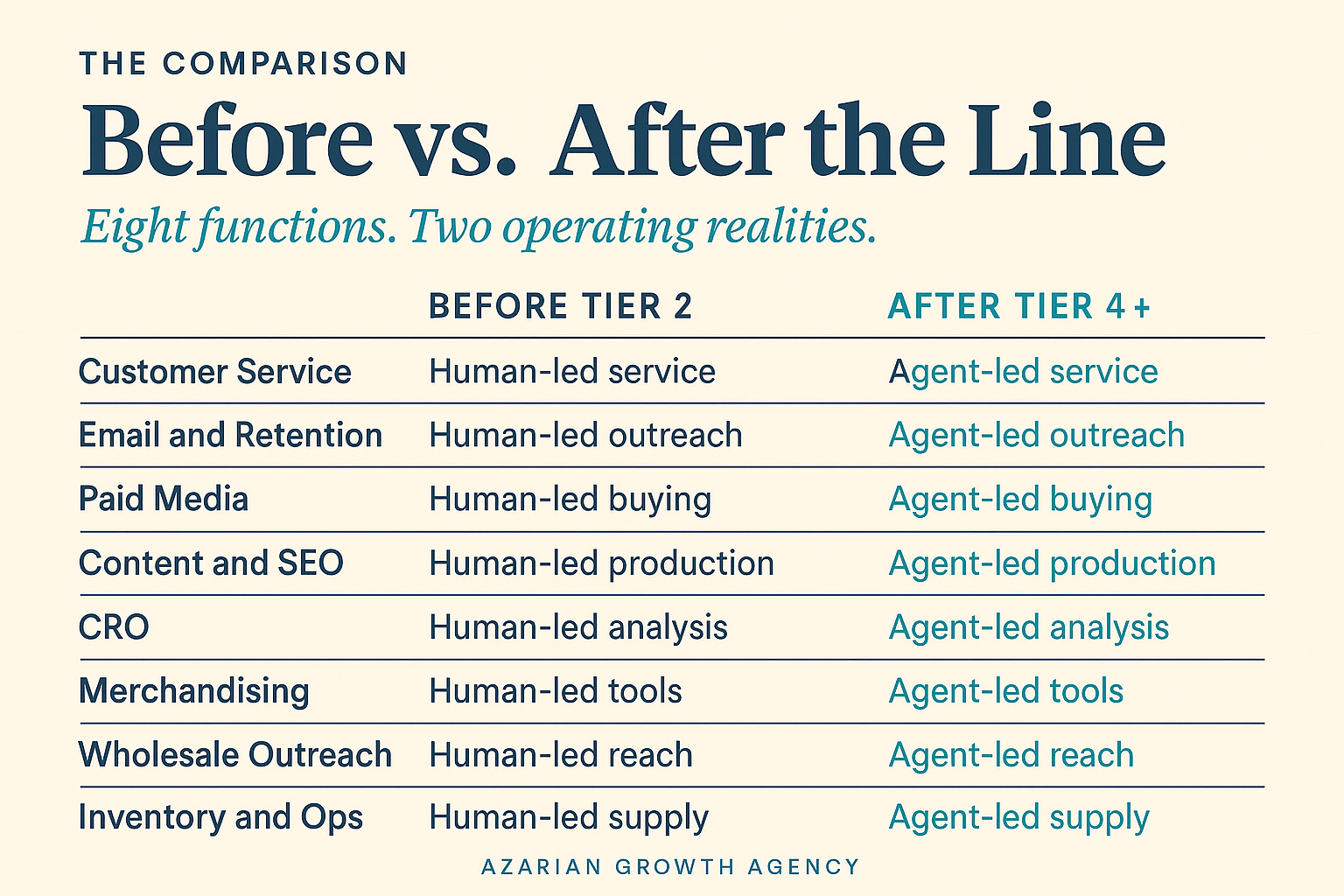
The Autonomy Line does not move uniformly across a business. A brand can be Tier 3 in email marketing and Tier 1 in inventory management simultaneously. What follows is a function-by-function breakdown — what Tier 2 looks like versus what Tier 4 looks like in practice.
1. Customer Service
Before the Autonomy Line (Tier 2): Your team uses AI to draft response templates. A human reviews every ticket and selects which template to send. AI shortens response time but every send requires a human decision. You are deflecting maybe 20–30% of volume with canned AI-assisted replies.
After the Autonomy Line (Tier 4+): An agent handles the full first-contact resolution loop for the top 80% of ticket types — order status, return initiation, exchange requests, basic troubleshooting — without human involvement. Escalation to a human is triggered automatically by sentiment signals, order value thresholds, or topic flags. CSAT is monitored by the same agent and surfaced weekly to the ops lead. The human team handles only the 20% that requires judgment. Resolution time drops from hours to minutes.
2. Email and Retention
Before the Autonomy Line (Tier 2): Your retention manager uses AI to write email copy and segment suggestions. They brief the AI, edit the drafts, build the flows manually in Klaviyo, and approve every send. AI is saving them 3–5 hours a week. The marketing calendar runs because a human is running it.
After the Autonomy Line (Tier 4+): A retention agent monitors cohort revenue curves and detects drop-offs without being asked. When a segment’s 60-day repeat rate dips below baseline, the agent identifies the cohort, generates a win-back sequence tailored to purchase history, stages the flows in Klaviyo, and queues them for a single approval click. Winback cadences, post-purchase sequences, and churn-risk campaigns run on behavioral triggers. The human sets the rules and reviews performance weekly. Nothing waits for someone to notice a problem.
3. Paid Media
Before the Autonomy Line (Tier 2): Your media buyer uses AI tools to generate ad copy variants and suggest audience segments. They still manually adjust budgets, pause underperformers, and make bid strategy decisions. AI is accelerating creative production but the media plan runs because a human is making calls every day.
After the Autonomy Line (Tier 4+): Budget reallocation across campaigns fires automatically based on ROAS thresholds set by the media lead. Creative refresh cycles are triggered when frequency caps or CTR decay signals hit defined levels. The agent generates and submits new ad variants — copy and targeting — and pauses underperformers without waiting for a weekly review meeting. The human’s job shifts from executing the media plan to setting the guardrails and reviewing results monthly.
4. Content and SEO
Before the Autonomy Line (Tier 2): A content manager uses AI to draft blog posts, product descriptions, and meta tags. They edit every draft, approve every publish, and build the content calendar manually. AI cut production time in half but the pipeline still depends on one person showing up.
After the Autonomy Line (Tier 4+): An SEO agent monitors keyword rankings, identifies gaps, and generates briefs. A content agent produces drafts from briefs and stages them in WordPress for editorial review. Product descriptions for new SKUs are generated automatically when catalog items are added. Internal link updates are suggested when new content is published. The content team reviews and approves — they do not produce. See AI Agentic Workflows: Adaptive and Self-Optimizing Systems for how these pipelines are built.
5. CRO (Conversion Rate Optimization)
Before the Autonomy Line (Tier 2): Your CRO team uses AI to generate A/B test hypotheses and copy variants. They manually set up tests in their platform, wait for statistical significance, and implement winners one at a time. AI is speeding up hypothesis generation, but the test-and-learn cycle is gated by human bandwidth.
After the Autonomy Line (Tier 4+): A CRO agent monitors conversion rates by page, session source, and device type. When a drop in a specific segment is detected, it generates a hypothesis, creates test variants, and sets up the experiment automatically. Winning variants are flagged for implementation. The agent logs every test and builds a compounding library of what converts for your specific audience. The human makes strategic decisions about priorities — not test configuration.
6. Merchandising
Before the Autonomy Line (Tier 2): The merchandising team uses AI to help with trend analysis and product copy. They manually manage the homepage grid, collection sorting, and featured product placement based on weekly gut checks and occasional data pulls.
After the Autonomy Line (Tier 4+): A merchandising agent re-sorts collection pages by real-time conversion rate and margin contribution. It surfaces underperforming products with an action recommendation — discount, bundle, or delist. When a product spikes in demand, it is surfaced to the homepage automatically. The human decides product strategy, not product placement order. Personalized storefront variants by traffic source or customer segment run without manual configuration.
7. Wholesale / B2B Outreach
Before the Autonomy Line (Tier 2): Your wholesale or B2B team uses AI to draft prospecting emails and build lists. A sales rep reviews every draft, personalizes them individually, and manually tracks follow-up timing in a spreadsheet or CRM.
After the Autonomy Line (Tier 4+): An outreach agent identifies target accounts based on ICP criteria, generates personalized outreach sequences, enrolls accounts in email cadences, and logs all activity to the CRM automatically. When a prospect replies, the agent flags it for human response. Follow-up timing and sequence branching run without manual intervention. The sales rep’s day is built around conversations, not prospecting administration.
8. Inventory and Operations
Before the Autonomy Line (Tier 2): The ops team pulls weekly inventory reports, uses AI to build reorder recommendations, and manually submits purchase orders after internal review. AI is helping with the analysis; a human is still executing every action.
After the Autonomy Line (Tier 4+): An inventory agent monitors sell-through rates by SKU, calculates reorder points dynamically based on lead time and sales velocity, and drafts purchase orders for approval. Stockout risk alerts are generated automatically before a problem occurs. When demand spikes unexpectedly — a product goes viral, a press mention drives traffic — the agent flags the inventory exposure in real time. The ops lead approves purchase orders; they do not build them.
For a full view of how these agent architectures connect, Marketing Automation 3.0: Workflows to Autonomous Agents covers the transition architecture in detail.
Why the $10M–$100M Window Is the Most Dangerous Place to Stand Still
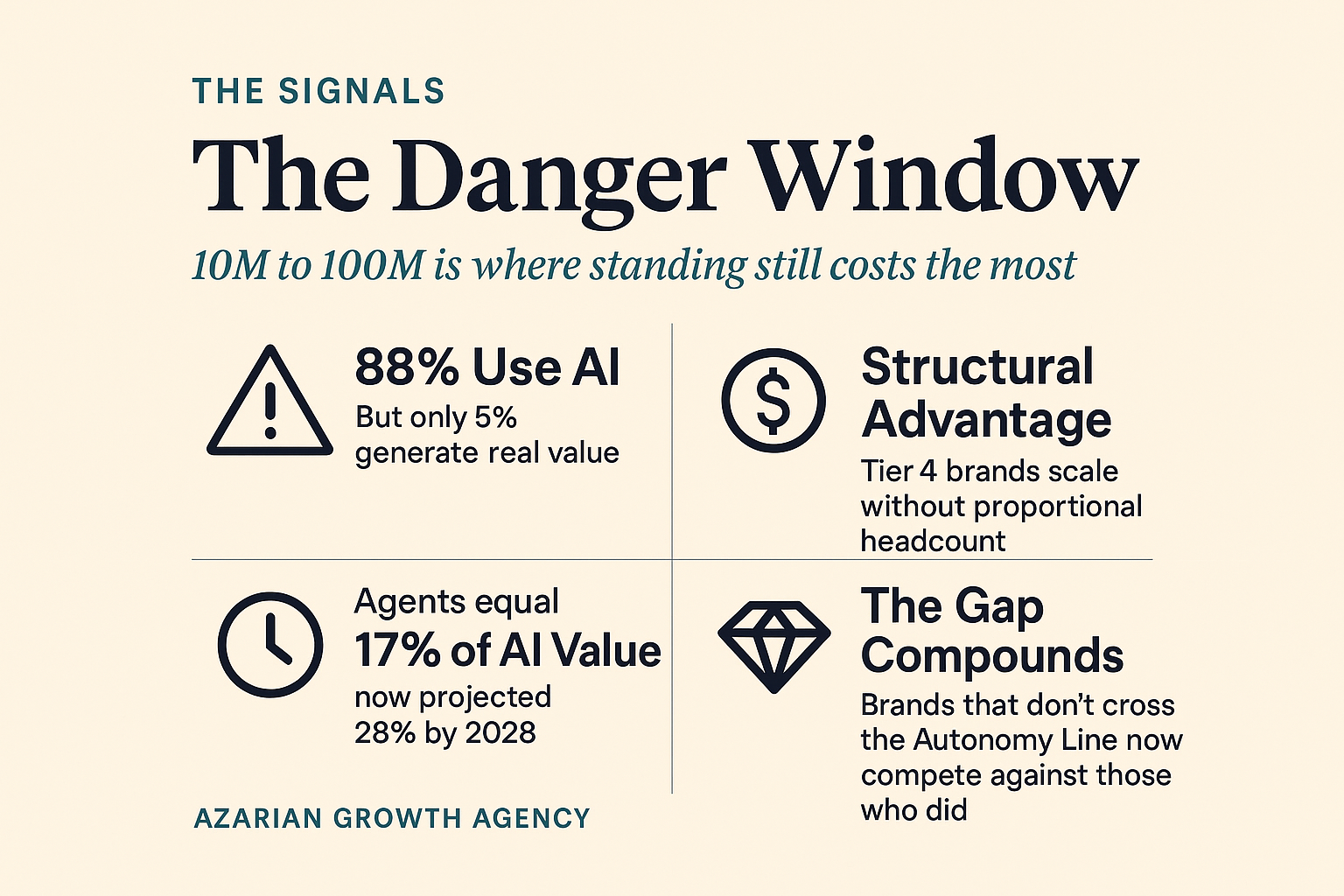
Enterprise brands are investing in agentic infrastructure at the platform level — Salesforce, Adobe, and Shopify are building agent layers directly into their products. Early-stage brands have lean operations, nothing to unlearn, and enough urgency that experimentation happens fast.
The $10M–$100M DTC brand is caught between both. You have real operational complexity — enough SKUs, enough customer volume, enough marketing channels that manual operations are genuinely expensive. But you also have enough momentum that the cost of not changing does not feel urgent. Revenue is growing. The team is working. The gaps are not visible in the quarterly review; they are visible only when you benchmark your output-per-headcount against an AI-operated brand running at the same revenue level with half the team.
According to McKinsey’s 2025 State of AI report, 88% of organizations now use AI in at least one business function. But BCG’s 2025 “Widening AI Value Gap” report — surveying 1,250 senior executives across nine industries — found that only 5% of companies qualify as “future-built” for AI, generating substantial value from their investments. The gap between adoption and value is enormous. The brands generating real leverage are not those with the most tools — they are the ones that crossed the Autonomy Line.
The compounding dynamic is what makes this window dangerous. A brand that builds Tier 4 operations at $20M is not just more efficient at $20M — it can scale to $50M without proportional headcount growth. The operational leverage is structural, not temporary. The brands that do not cross the Autonomy Line now will spend more to grow less and then compete against brands with a structural cost and speed advantage they cannot close by hiring.
BCG’s data reinforces the urgency: agents already account for 17% of total AI value in 2025 and are projected to reach 29% by 2028. Future-built companies allocate 15% of their AI budgets to agents. Laggards? Almost none are using agents at all.
One DTC brand we worked with was doing $20M in revenue with a 6-person marketing team operating entirely at Tier 2. Within 90 days of crossing the Autonomy Line — deploying agents for content production, email retention, and competitive monitoring — their organic traffic grew 3x while the team’s time shifted from producing to governing. The agents didn’t replace the team. They made the team strategic.
How to Know Which Tier You Are Actually On
Stop estimating. Answer these three questions honestly.
Frequently Asked Questions
How many of your team’s daily workflows are initiated by a human versus triggered automatically?
Count the workflows your team runs in a typical day — email sends, ad adjustments, content publishing, customer replies, inventory reorders, outreach sequences. For each one, ask: does this run because someone decided to do it today, or does it run because a system detected a condition and executed? If more than 80% require a human to initiate, you are below the Autonomy Line. This is the single clearest indicator of your real tier. Most brands doing this count for the first time discover they are at Tier 1 or Tier 2, not Tier 3.
When AI produces an output, does a human redo it, edit it, or simply approve it?
There is a significant operational difference between these three outcomes. If humans are redoing AI outputs — treating them as a rough starting point that requires substantial rework — you are getting marginal leverage at best, and your team may be spending more time on AI management than it saves. If humans are editing, you are at Tier 2–3. If humans are approving with minimal changes, you are approaching the Autonomy Line. If the outputs are trusted enough to require only periodic spot-checking, you are above it. Be honest about which of these actually describes your day-to-day, not your aspirational use case.
Could your current AI setup run for 48 hours without a human check-in and produce something useful?
This is the most direct test of whether you have crossed the Autonomy Line. If the answer is no — if your AI systems go quiet the moment everyone logs off — you have tools, not agents. Agents do not need supervision to produce. They produce based on triggers, schedules, and data signals. A 48-hour autonomous run is not the goal; it is the diagnostic. If the idea of it sounds either impossible or anxiety-inducing, your current system design has not crossed the Autonomy Line regardless of what tools your team is using.
What is the Agentic Operating Model?
The Agentic Operating Model is a six-tier AI maturity framework developed by Hamlet Azarian at Azarian Growth Agency. It maps the spectrum from fully manual operations (Tier 1) to compounding autonomous systems (Tier 6), with the Autonomy Line marking the inflection point where agents begin initiating work independently of human prompts. The framework is designed to help e-commerce operators benchmark their real operational tier — not their tool adoption — and prioritize the systems investments that move them across the Autonomy Line.
What is the Autonomy Line in AI operations?
The Autonomy Line is the inflection point in the Agentic Operating Model where work shifts from human-initiated to agent-initiated. Below the Autonomy Line (Tiers 1–3), humans prompt AI tools and approve every output. Above it (Tiers 4–6), agents detect conditions, execute workflows, and surface outputs for human governance rather than human initiation. Crossing the Autonomy Line is a structural systems decision — not a software purchase.
How does an e-commerce brand cross the Autonomy Line?
Crossing the Autonomy Line requires three things: identifying which workflows in your business can be trigger-based rather than human-initiated, building or deploying agents with access to the relevant data and tools, and shifting your team’s role from executing those workflows to governing the agents that run them. The most common starting points for e-commerce brands are retention email automation, customer service deflection, and inventory monitoring — all high-volume, rule-amenable workflows where agent initiation delivers immediate leverage.
If you want the full picture — scored by function, benchmarked against brands at your revenue stage, with a prioritized roadmap — that is what the AGA growth diagnostic produces. It is a structured 90-minute session that maps the gaps in your current marketing and operations system and outputs a prioritized plan for crossing the Autonomy Line. Book your free growth diagnostic here.
The Autonomy Line Is Not a Technology Decision
Every tier in the Agentic Operating Model has the same tools available to it. The brands operating at Tier 4 and above are not using different software than the brands stuck at Tier 2. They made a different systems decision — which workflows get handed to agents, what authority those agents hold, and how the human team’s role shifts from executing to governing.
The gap between Tier 2 and Tier 4 is not a software purchase. It is a structural decision about who initiates work. Crossing the Autonomy Line means building systems that run because data says so — not because someone showed up and noticed a problem. For e-commerce brands in the $10M–$100M range, that decision compounds. The brands that make it now will scale with operational leverage their competitors cannot replicate by hiring.
The brands winning on operational efficiency in 2026 are not the ones with the most AI subscriptions — they are the ones that crossed the Autonomy Line.
Written by Hamlet Azarian, CEO of Azarian Growth Agency. Hamlet has spent 10+ years building performance marketing systems for growth-stage companies, PE-backed portfolio companies, and e-commerce brands. He built AI marketing systems and autonomous agent workflows before most agencies understood what an MCP was. The Agentic Operating Model is an original AGA framework for benchmarking AI operational maturity.

