

There is a math problem sitting on the desk of almost every growth-stage CMO right now. The board expects 15 to 20 percent revenue growth. The marketing budget grew by roughly 2 percent. Headcount is frozen or declining. And CAC has surged 222 percent over the past eight years.
The traditional answer was to hire more. More SDRs, more content writers, more demand gen specialists. That answer no longer works when boards are evaluating capital efficiency alongside growth rate.
The new answer is a redesigned demand generation motion built around AI, one that lets a team of four to eight people produce the pipeline output that used to require fifteen. The session More Output, Same Team covers exactly how this works end-to-end. This post covers the demand gen piece specifically: where the economic leverage lives, which channels AI affects most, and what the operational workflow looks like for a lean team that needs to hit pipeline targets with the people it already has.
What Is Demand Generation Marketing? And Why the Definition Matters Now
Understanding what demand generation marketing actually means is essential before rethinking how AI fits into it, because most growth-stage teams have been running lead generation programs and calling them demand generation programs.
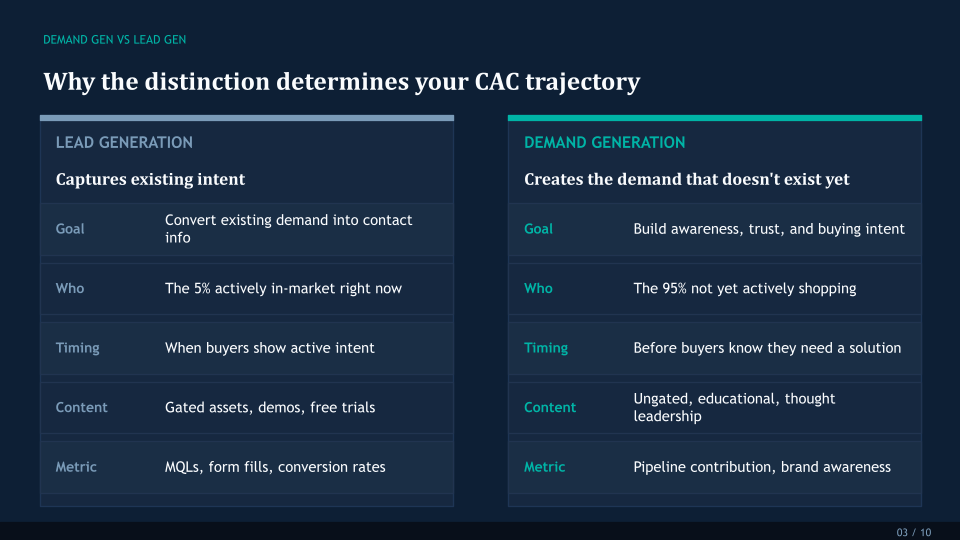
Demand generation is the process of creating awareness, trust, and buying intent among target accounts long before they fill out a form or talk to a salesperson. It covers every interaction from first brand discovery through the moment a prospect decides they need what you offer. The goal is not to capture information from people who are already looking. The goal is to create the conditions that make them start looking.
This is fundamentally different from lead generation, which is the process of converting existing intent into contact information. Lead gen captures demand. Demand gen creates it.
The practical difference shows up in the numbers. Cognism shifted from lead gen to demand gen and watched their close rate on inbound inquiries climb from 0.2 percent to nearly 20 percent, while the pipeline grew from $2 million to $13 million. The leads that come from real demand creation are not just more numerous. They are qualitatively different buyers who already understand why they need what you sell.
The reason this distinction matters in an AI context is that AI changes the economics of demand creation more dramatically than it changes the economics of demand capture. Running more ads and capturing more form fills is relatively straightforward. Building the awareness and trust infrastructure that generates qualified inbound at scale is where lean teams have historically struggled, and it is exactly where AI creates the most leverage.
The Problem Driving the Demand Gen Redesign
Three compounding pressures are forcing this redesign at growth-stage companies right now.
CAC is structurally higher. B2B customer acquisition costs have increased 40 to 60 percent from 2023 to 2025. The median SaaS company now spends $2.00 to acquire $1.00 of new ARR, according to Benchmarkit’s 2025 SaaS Performance Metrics research. CAC payback for private SaaS companies now averages 23 months, meaning nearly two years to recover acquisition costs before a customer becomes profitable.
Budgets are flat while expectations grow. Gartner’s 2025 CMO Spend Survey of 402 CMOs found that 59 percent report having insufficient budget to execute their strategy. Marketing budgets have flatlined at 7.7 percent of revenue while boards continue expecting mid-double-digit growth.
The buyer journey has moved earlier. According to 6sense research across 4,000 buyers, 94 percent of buying groups have already ranked their preferred vendors before contacting any of them. 83 percent of B2B buyers complete 70 percent of their research before engaging a salesperson. The decision is effectively made before sales knows the conversation is happening. If your brand is not present during the awareness and consideration phase, you are not in the consideration set by the time the buyer reaches out.
These three forces together create the demand generation mandate: show up earlier in the buyer journey, build trust before your competitors do, and do it with the team size you have.
How AI Changes the Economics
The economic shift AI enables in demand generation is not primarily about doing the same things faster. It is about doing things that were previously impossible for a lean team.
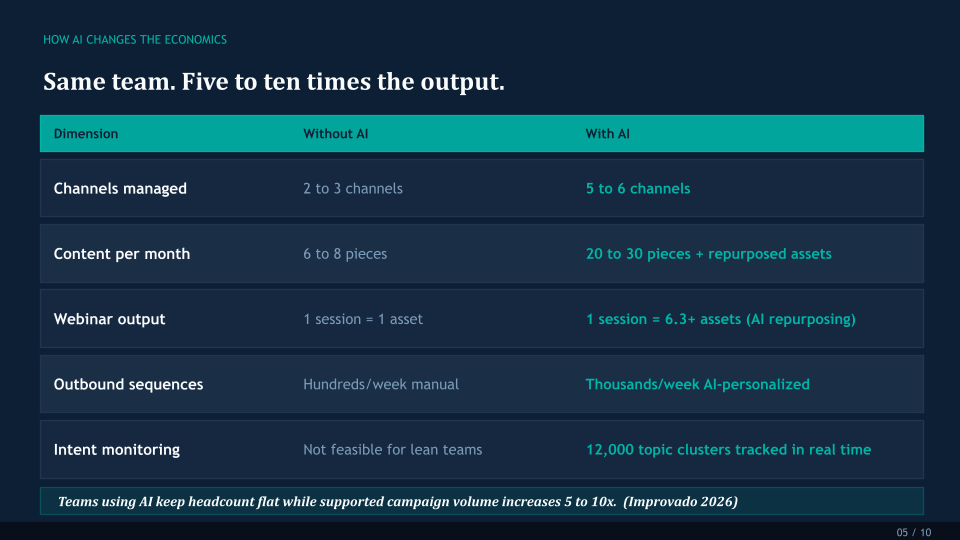
A four-person demand gen team without AI can realistically manage two to three channels, publish six to eight pieces of content per month, run one to two webinars per quarter, and send a few hundred personalized outbound sequences per week. With AI embedded in the workflow, that same team can manage five to six channels, publish 20 to 30 pieces of content per month, extract 6.3 new assets from every webinar, send thousands of AI-personalized sequences per week, and monitor intent signals across 12,000 topic clusters in real time.
Improvado’s 2026 research found that teams using AI kept headcount flat while supported campaign volume increased five to ten times. ZoomInfo’s 2025 survey of more than 1,000 GTM professionals found a 47 percent productivity boost among AI users, saving an average of 12 hours per week per person.
The Insight Partners 2025 B2B Pipeline Generation Survey found that approximately 80 percent of companies report AI has a positive impact on pipeline generation. Insight Partners VP Dustin Zaloom noted that nearly twice as many companies expect to reduce headcount as increase it, while technology and program spend is expected to increase. The direction is clear: invest in AI infrastructure, not bodies.
The Demand Gen vs. Lead Gen Distinction at Scale
A brief note on terminology before covering the channels, because getting this wrong leads to misallocated budget.
Demand gen vs. lead gen is a distinction about timing and intent. Demand generation reaches approximately 95 percent of your target market that is not actively shopping. Lead generation converts the approximately 5 percent that is. Most companies over-invest in lead gen and under-invest in demand gen, which is why their CAC keeps rising: they are fishing in an increasingly crowded, increasingly expensive pond.
The right budget split according to evidence from Binet and Field’s effectiveness research is roughly 60 percent on brand and demand creation and 40 percent on demand capture. Most growth-stage B2B companies are running the reverse, spending the majority on paid search and outbound, while their category-level awareness stays flat. AI makes it economically viable for a lean team to fix this allocation without adding headcount.
The Five Channels of an AI-Powered Demand Generation Strategy
Content and SEO: The Foundation
Content remains the most effective demand generation tactic in B2B, used by 83 percent of teams and rated most effective for awareness generation. B2B SaaS SEO achieves 702 percent ROI over three years compared to roughly 155 percent for paid search, according to First Page Sage modeling. Content marketing costs 62 percent less than traditional marketing while generating three times more leads.
The AI-powered content workflow that creates real demand gen leverage is the pillar and spoke model. One comprehensive piece of anchor content, a research report, a definitive guide, or a webinar session, becomes the source for dozens of derivative assets. AI extracts and reformats: LinkedIn posts highlighting individual data points, short-form video scripts, email newsletter sections, blog posts expanding on subtopics, slides, infographics, and FAQ content for SEO.
Goldcast’s benchmark research across 19,531 webinars found that 65 percent of marketers repurpose webinar content, generating an average of 6.3 new content assets per webinar. AI video clips from webinars increased 2,903 percent from 2023 to 2024. The economic equation: one session of content creation produces weeks of distribution.
GEO: The Emerging Demand Gen Channel
Generative Engine Optimization is now a legitimate component of a b2b demand generation strategy and is currently wide open from a competition standpoint.
46 percent of B2B buyers now use generative AI tools such as ChatGPT and Perplexity for preliminary research. AI referral traffic converts at 3.76 percent on average, 216 percent higher than standard web traffic, because users arriving from AI-generated answers are further along in their buying decision. GEO already represents 4 percent of marketing-sourced pipeline across the Insight Partners portfolio despite being a brand-new channel.
The content type that earns citations in AI-generated answers is original quantitative research. One company saw 847 citations across AI engines in 90 days from a single research report. Semantic content clustering generates three to four times more citations per article than keyword-focused approaches. The lesson: if your competitors are not publishing original research, publishing it now creates a sustainable citation advantage before the channel becomes crowded.
Signal-Based and Intent-Driven Demand Gen
The most significant structural change AI enables in demand generation is the ability to identify and act on buyer intent signals before competitors see them.
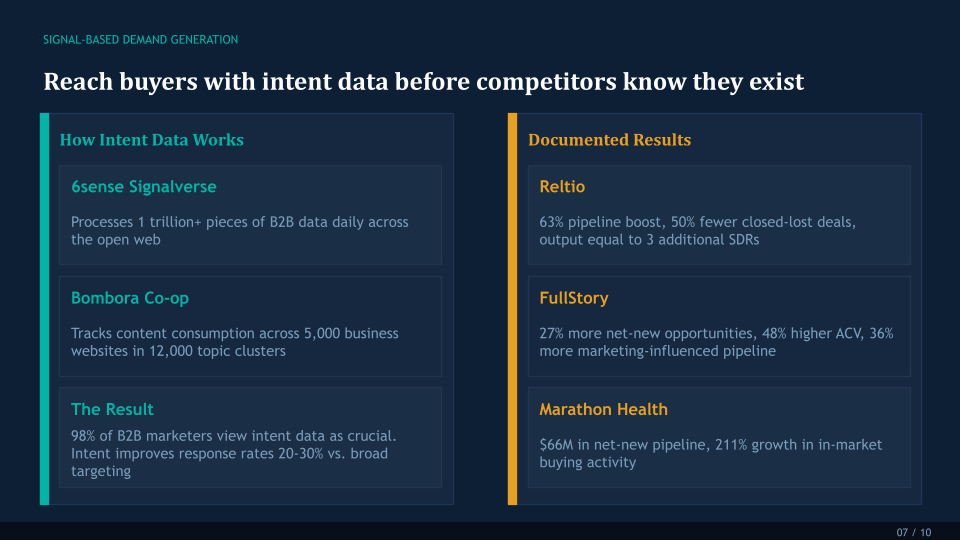
Intent data platforms like 6sense and Bombora track content consumption across thousands of B2B websites, identifying which companies are researching topics related to your category. 6sense processes over a trillion pieces of B2B data daily. Bombora monitors content consumption across 5,000 business websites organized into 12,000 topic clusters. 98 percent of B2B marketers view intent data as crucial for successful demand gen.
The results from documented implementations are substantial. FullStory used 6sense and saw a 27 percent increase in net-new opportunities in a single quarter, a 48 percent increase in ACV for in-market accounts, and a 36 percent increase in marketing-influenced qualified pipeline quarter over quarter. Reltio used 6sense Conversational Email AI and generated a 63 percent boost in revenue pipeline, a 50 percent reduction in closed-lost opportunities, and output equivalent to three additional SDRs without adding a single person.
For growth-stage teams with limited budgets, Bombora offers faster time to value and more accessible pricing than 6sense’s enterprise tier. Factors.ai provides a mid-market entry point that integrates intent signals directly into CRM workflows.
Paid Demand Generation
The paid demand generation landscape in B2B has consolidated significantly. Dreamdata’s 2026 benchmarks across 66 million sessions and 3.5 million customer journeys found that LinkedIn is the only major paid platform delivering positive ROAS for B2B at 121 percent, while Google non-branded search dropped from 37 percent to 33 percent of budgets with CPCs up 29 percent, and Meta delivered a 51 percent ROAS.
56.4 percent of B2B marketers plan to increase LinkedIn budgets by more than 10 percent in 2026. LinkedIn Thought Leader Ads, which promote individual founder or executive content rather than brand pages, generate 10 to 20 percent CTR for cold audiences and up to 45 percent brand lift. LinkedIn leads are 277 percent more effective than Facebook leads for B2B conversion.
Google’s Demand Gen campaigns are the relevant AI-powered campaign type for awareness-stage demand generation on Google’s network. Google reports that advertisers adopting best practices saw 40 percent more conversions, 58 percent higher ROAS than Video Action Campaigns, and 61 percent lower cost per action. One important operational note: set Demand Gen budgets at 15 times the target CPA and disable Optimized Targeting initially to avoid inflated conversion metrics from engaged view conversions that do not represent genuine qualified interest.
The AI layer in paid demand gen is primarily in creative testing and audience signal optimization. AI can generate and test 20 or more ad copy variants in a fraction of the time manual production requires. Meta Advantage+ and LinkedIn’s predictive targeting algorithms use AI to optimize delivery, which is where the lean team advantage comes from: AI handles the tactical optimization that previously required a specialist per channel.
Webinar-Led Demand Generation
Webinars remain the highest-rated lead quality source for B2B marketers. Goldcast’s 2025 benchmarks found that 73 percent of B2B marketers rate webinars as their number one source of high-quality leads. Average webinar CPL sits at approximately $72, compared to $181 for PPC and $811 for trade shows. 20 to 40 percent of webinar attendees convert to qualified leads. Webinar ROI for B2B SaaS ranges from 213 percent to 430 percent.
The demand generation value of webinars has always been high. The operational barrier for lean teams was production time. AI eliminates most of that barrier. AI-powered repurposing workflows extract clips, generate transcripts, produce blog post drafts, create email nurture sequences, build LinkedIn post series, and format slide summaries from a single session. ON24’s 2025 data showed that AI-assisted nurture sequences increased average attendees by 32 percent and on-demand attendees by 69 percent.
For a repeatable demand generation funnel built around webinars, the operating model is simple: host monthly or quarterly sessions on topics your ICP is actively researching, repurpose aggressively with AI, and use each session as the anchor for a full content cycle. The Webinar 18 series, this post is part of, demonstrates exactly this model.
AI-Powered Outbound as a Demand Generation Channel
There is an important distinction between outbound as demand generation and outbound as lead generation. Outbound that leads with cold pitches is lead gen. Outbound that leads with insight, triggered by intent signals, that teaches a prospect something they did not know about their own business is demand gen.
B2B cold email benchmarks show a wide range: the industry average reply rate is 3 to 5 percent, but top-quartile performers achieve 15 to 25 percent through tight ICP targeting, intent signal triggers, and personalization. AI personalized campaigns show a 3.2 percent positive reply rate, two to three times the 1 to 1.5 percent template-based average, according to LeadHaste analysis of more than 10 million emails.
Advanced personalization at the research level, referencing specific business context rather than just inserting a first name, produces reply rates up to 18 percent versus roughly 9 percent for generic sequences. The key insight is that only 5 percent of senders personalize every email at a meaningful depth level. Those who do see a two to three times performance improvement.
Clay is the current leading platform for AI-powered outbound demand gen for growth-stage companies. It pulls data from 150 or more data providers to build prospect profiles, then uses AI to generate personalized outreach at scale. It is used internally at OpenAI, Anthropic, and Intercom. Monthly pricing runs $149 to $749, depending on credit volume.
The Demand Generation Metrics That Actually Matter
What to track
The purpose of demand generation is to build a pipeline. The metrics that connect demand gen activity to pipeline contribution are: pipeline coverage ratio, pipeline velocity, CAC by source, and MQL to SQL conversion rate by channel.
Pipeline coverage ratio should be 3 to 5 times quota, depending on win rate. At the industry average win rate of 21 percent, you technically need 5x pipeline to hit quota. Most growth-stage companies are running at 2 to 2.5x and wondering why they miss numbers.
The channel-level insight that changes budget decisions: SEO-generated MQLs convert to SQLs at 51 percent. Email-nurtured leads convert at 46 percent. Webinars at 30 percent. PPC at 26 percent. These are not small differences. A reallocation of budget from paid search toward content and organic demand creation is not just a cost efficiency play. It is a conversion quality play.
Speed to pipeline matters as much as volume
Speed-to-lead has an outsized impact on pipeline creation. Follow-up within one hour produces 53 percent conversion on qualified inquiries. Follow-up after 24 hours drops to 17 percent. AI-powered nurture sequences triggered by behavioral signals, content engagement, intent data spikes, make real-time follow-up achievable for a lean team.
The attribution challenge
99 percent of self-reported attribution differs from software-reported attribution. For a lean team, the practical approach is to run first-touch and last-touch attribution in your CRM alongside a self-reported question in every demo request or contact form: how did you first hear about us. The combination of behavioral data and self-reported data provides more actionable signal than either alone.
Implementation Roadmap: The First 60 Days
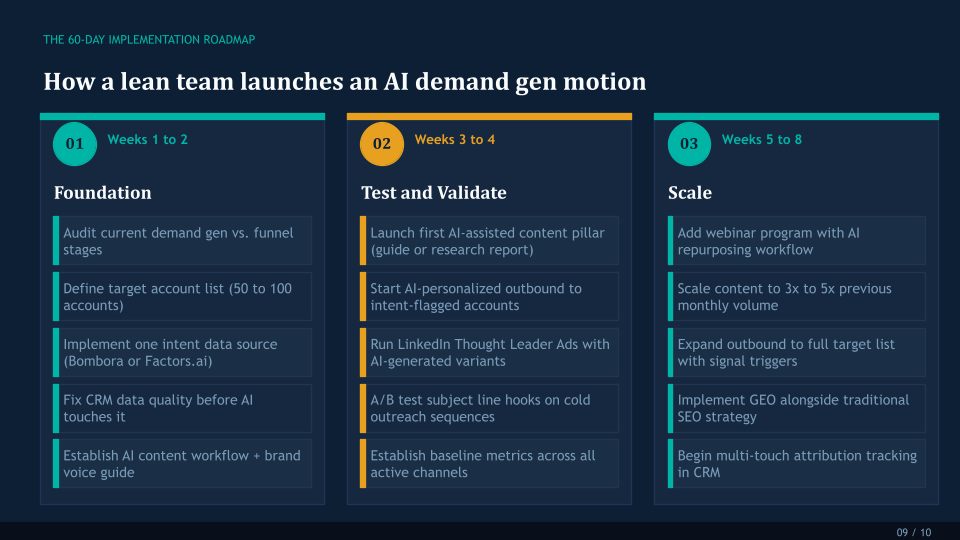
Weeks 1 and 2: Foundation. Audit current activities against funnel stages. Define a target account list of 50 to 100 accounts. Implement one intent data source. Establish an AI content workflow with brand voice guidelines. Fix CRM data quality before AI touches it.
Weeks 3 and 4: Test and validate. Launch first AI-assisted content pillar. Start AI-personalized outbound sequences to intent-identified accounts. Run LinkedIn Thought Leader Ads with AI-generated creative variants. Establish baseline metrics across all channels.
Weeks 5 through 8: Scale. Layer in a webinar program with an AI repurposing workflow. Scale content to three to five times the previous volume. Expand outbound to the full target account list with signal triggers. Implement the GEO strategy alongside SEO. Begin multi-touch attribution tracking.
The most common implementation failures to avoid: starting with AI tools instead of business problems, expecting pipeline results before 60 to 90 days, neglecting email deliverability infrastructure (SPF, DKIM, DMARC are non-negotiable post-2024 requirements), and over-indexing on MQL volume over pipeline quality.
Budget Allocation Framework
For a $200K to $500K annual demand generation for SaaS budget, the evidence-backed allocation is: content, SEO, and GEO at 25 to 30 percent (702 percent 3-year ROI), paid demand gen primarily LinkedIn at 25 to 30 percent (121 percent ROAS), AI tools and intent data at 15 to 20 percent ($2,000 to $8,000 per month covers Clay, intent data, and AI content tools), webinars at 10 to 15 percent (73 percent of marketers rate as the top lead quality source), and outbound infrastructure at 5 to 10 percent.
The reframe that makes this allocation work politically is that AI tooling is not an add-on to headcount. It is a substitute for headcount. A $4,000 to $8,000 monthly AI stack delivering 5 to 10 times campaign volume is not a technology expense. It is the equivalent of two to three additional FTEs that do not require benefits, management overhead, or severance when the strategy shifts.
About Azarian Growth Agency
Azarian Growth Agency is a full-funnel, AI-native growth marketing agency. We work with growth-stage B2B companies, SaaS platforms, and mid-market enterprises to build demand generation systems that fill the pipeline without requiring proportional headcount growth.
The frameworks in this post are how we build demand gen programs for clients: intent data integrated with content, AI-powered outbound that reads as human, paid channels optimized for demand creation rather than demand capture, and measurement systems that connect early-stage brand investment to late-stage pipeline contribution.
The More Output, Same Team session is the complete operational picture. We cover how growth-stage teams are restructuring their entire marketing motion around AI, what the team roles look like, how the budget shifts, and how to present the efficiency case to a board that is asking for more pipeline with the same resources. If your pipeline is not growing at the rate your revenue targets require, this is where to start.

