

Voice search conversion optimization represents the next frontier in landing page performance. Business owners and CEOs must now optimize for visitors arriving from Alexa, Siri, ChatGPT Voice, and Google Assistant, as these users demonstrate fundamentally different behavior and expectations.
The opportunity is massive. 8.4 billion voice assistants are now in use globally, outnumbering the world’s population. Moreover, voice-influenced shoppers convert at higher rates when landing pages accommodate their conversational search patterns and immediate intent.
In this guide, we’ll break down how user behavior differs for voice-originated traffic, reveal landing page structures that convert conversational visitors, and provide copy frameworks specifically optimized for voice search CRO.
Understanding Voice Search Conversion Optimization
Voice search conversion optimization adapts landing pages for visitors who arrive through spoken queries rather than typed keywords. These users interact with brands differently, bringing distinct expectations shaped by conversational AI interactions.
Furthermore, voice searchers demonstrate higher commercial intent. When someone speaks, “find plumbers near me open now,” they need immediate service. This urgency creates conversion opportunities when landing pages deliver quick, actionable information.
Traditional landing pages optimized for typed queries often fail voice traffic. Long paragraphs, complex navigation, and buried contact information frustrate users expecting immediate answers. Conversion rate optimization agency expertise becomes essential for adapting pages to voice-influenced behavior patterns.
How Voice Search Users Behave Differently
Voice searchers use natural language rather than keyword phrases. Instead of typing “Italian restaurant Brooklyn,” they ask, “What’s the best Italian restaurant near me?” This conversational style requires a different content structure and copy approach.
Consequently, 65% of people aged 25-49 speak to voice-enabled devices at least once daily. This demographic represents prime business value: established careers, disposable income, and active purchasing behavior.
Voice queries average 29 words compared to 2-3 words for typed searches. This length reflects how people naturally speak. Your landing page copy must address these longer, more specific queries directly.
The Mobile-First Reality of Voice Traffic
Smartphones account for 56% of all voice search usage, making mobile optimization non-negotiable. Voice searchers on mobile demand instant page loads and immediately visible information.
Moreover, 78% of location-based mobile searches result in offline purchases. When someone searches by voice for local services, they’re ready to buy. Your landing page has seconds to capture this high-intent traffic.
Core Web Vitals matter more for voice traffic than traditional visitors. Slow-loading pages lose voice searchers who expect the speed and efficiency they get from voice assistants themselves.
Conversational AI Landing Pages: Structure That Converts
Conversational AI landing pages prioritize immediate answers over persuasive narratives. The structure must deliver key information within the first screen, matching the quick-answer expectation that voice assistants establish.
Additionally, the inverted pyramid approach places critical information first: what you offer, location, availability, and contact options. Supporting details and persuasive content follow for users who want depth.
AI content optimization ensures copy speaks naturally, mirroring how people ask questions. This alignment between user query language and page content creates instant relevance recognition.
Above-the-Fold Essentials for Voice Traffic
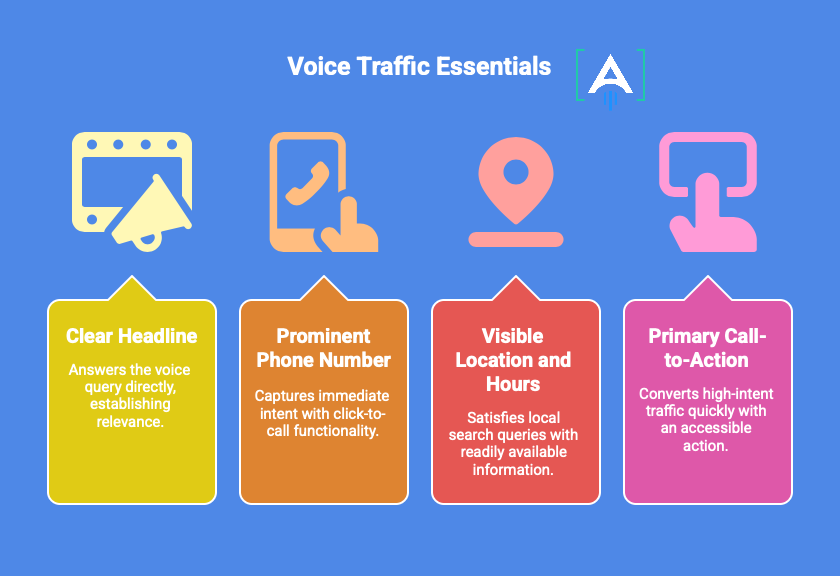
Clear headline answering the voice query directly establishes immediate relevance. If someone asks “Who does emergency plumbing in Brooklyn,” your headline should state “24/7 Emergency Plumbing Services in Brooklyn.”
Prominent phone number with click-to-call functionality captures immediate intent. Voice searchers on mobile expect one-tap calling without scrolling or searching.
Location and hours visible immediately satisfy local search queries. Voice users asking about nearby services need this information before anything else.
Primary call-to-action above the fold converts high-intent traffic fast. Whether “Call Now,” “Get Directions,” or “Book Appointment,” the action must be instantly accessible.
Furthermore, content marketing strategies must adapt to voice search patterns. Traditional SEO content structures fail when voice traffic expects immediate, specific answers.
Question-Answer Content Architecture
Voice queries are questions. Your content must provide direct answers in 2-3 sentence blocks that voice assistants can extract and read aloud.
Structure content with question-formatted H2 headings followed by concise answers. This format aligns perfectly with how voice assistants parse and present information. For instance, “What services do you offer?” followed by a brief list and description.
FAQ sections optimized for voice address multiple query variations. Voice searchers ask questions conversationally, so your FAQ should include natural language variations covering different ways people might ask the same thing.
Use simple language and short sentences. Voice assistants read your content aloud, so it must sound natural when spoken. Avoid jargon, complex terminology, and long compound sentences.
Voice Commerce Optimization: Converting Voice Shoppers
Voice commerce represents an enormous opportunity. Voice shopping reached $3.3 billion in consumer spending, with projections hitting $45 billion by 2028. Consequently, e-commerce landing pages must accommodate voice-influenced purchase journeys.
Moreover, 51% of voice shoppers use voice to research products, while 22% make direct purchases through voice interfaces. Your landing pages must serve both research and purchase intents effectively.
Voice shoppers value convenience above all. They use voice search specifically to avoid typing and clicking through multiple pages. Landing page design must minimize friction at every step.
Product Pages for Voice Discovery
Concise product descriptions lead with key specifications voice shoppers request. When someone asks “What’s the battery life of [product],” your page should answer this immediately.
Structured data markup helps voice assistants extract accurate information. Schema.org product markup ensures pricing, availability, and specifications appear in voice search results correctly.
Clear pricing and availability visible without scrolling satisfy purchase-ready voice searchers. Hide these details, and you lose conversions to competitors showing them prominently.
Additionally, social media marketing integration matters for voice commerce. Voice shoppers often research on voice, then verify through social proof before purchasing.
Form Optimization for Voice-Influenced Traffic
Traditional multi-step forms frustrate voice-influenced visitors expecting quick interactions. Simplify ruthlessly, requesting only essential information.
Single-column layouts work better on mobile devices where voice traffic concentrates. Multi-column forms require pinching and zooming, which destroys conversion rates.
Auto-fill and smart defaults reduce typing burden. Voice searchers hate typing; they use voice to avoid it. Pre-populate what you can and make the remaining fields effortless.
Progress indicators for multi-step processes set expectations. Voice users want to know exactly how much effort remains before completion.
Copy Frameworks for Conversational Interface CRO
Voice search CRO copy speaks directly to users in natural language. Forget keyword-stuffed headlines and instead write how people actually talk.
Consequently, first-person and second-person language creates conversational connection. “We help you find…” or “You’ll get…” sounds natural when voice assistants read it aloud, unlike third-person corporate speak.
Action-oriented copy moves voice searchers toward conversion quickly. These users arrived seeking specific solutions, so your copy should guide them efficiently toward next steps.
Writing Headlines That Answer Voice Queries
Voice queries often start with who, what, where, when, why, or how. Your headlines should answer these question formats directly.
Instead of “Premium Plumbing Services,” write “Who Provides Emergency Plumbing in Brooklyn?” This matches actual voice queries and signals immediate relevance.
Benefit-focused subheadlines elaborate on headlines without requiring additional clicks. Voice traffic wants complete answers on one page, not scattered across navigation structures.
Use numbers and specifics when possible. “Available 24/7” converts better than “Always available” because it answers the specific question “When are you open?”
Call-to-Action Language for Voice Searchers
Voice traffic responds to direct, action-oriented CTAs. “Call Now,” “Get Directions,” “Book Today” clearly state what happens next.
Additionally, AI marketing agency specialists test CTA variations specifically for voice traffic. Performance differs from traditional typed search visitors, requiring dedicated optimization.
Create urgency appropriately. Voice searchers often have immediate needs, so “Available Now” or “Next Appointment in 2 Hours” converts high-intent traffic effectively.
Technical Requirements for Voice Search Landing Pages
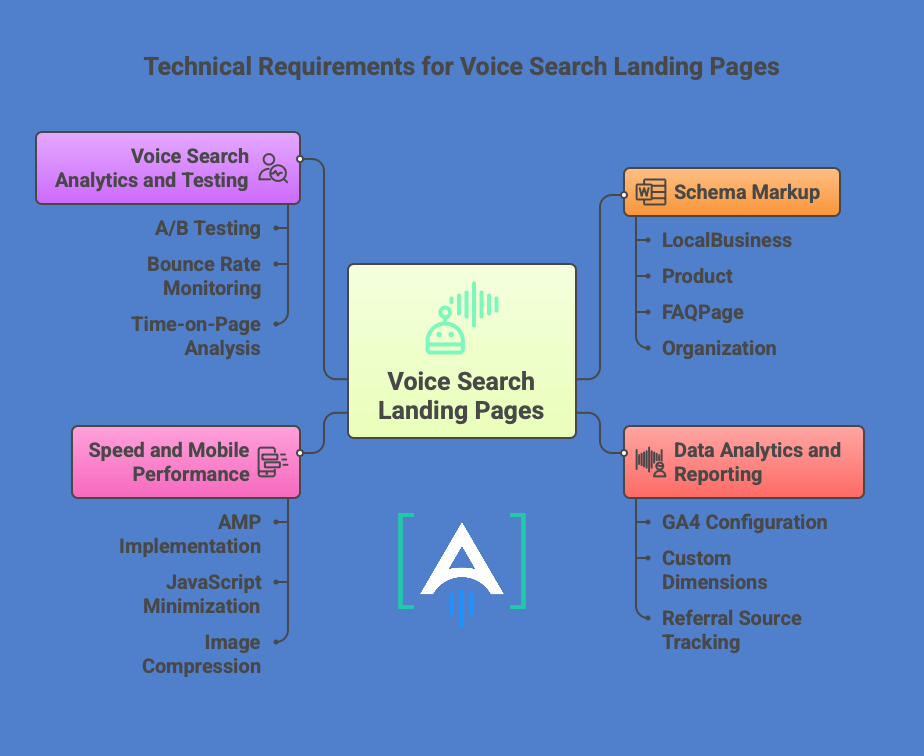
Voice-optimized landing pages require specific technical implementation beyond traditional SEO. These elements ensure voice assistants can access, understand, and recommend your content.
Schema markup provides structured data voice assistants extract directly. Implement LocalBusiness, Product, FAQPage, and Organization schemas depending on your business type.
Furthermore, data analytics and reporting platforms must track voice traffic separately. These visitors behave differently, requiring dedicated analysis and optimization.
Speed and Mobile Performance
Voice search results load in just 4.6 seconds on average – 52% faster than regular results. Your landing pages must match or beat this speed to retain voice traffic.
Implement AMP (Accelerated Mobile Pages) for ultra-fast mobile loading. While not mandatory, AMP pages provide the instant-load experience voice searchers expect.
Minimize JavaScript that blocks rendering. Voice traffic abandons slow pages immediately because voice assistants set expectations for instant information delivery.
Compress images aggressively and use lazy loading. Every millisecond matters when competing for voice search conversions against faster-loading competitors.
Voice Search Analytics and Testing
Configure GA4 to identify voice traffic through custom dimensions. Track referral sources from voice assistants and segment this traffic for dedicated analysis.
A/B test specifically for voice traffic segments. What converts typed search visitors may underperform for voice arrivals. Run parallel tests comparing voice versus typed traffic performance.
Monitor bounce rates and time-on-page for voice segments. High bounce rates signal content mismatch between user query intent and landing page delivery.
Measuring Voice Search CRO Success
Traditional conversion metrics remain important, but don’t capture voice-specific performance. Expand measurement frameworks to include voice-influenced indicators.
Track phone calls as conversions, not just form submissions. Voice traffic converts heavily through calls rather than forms, as speaking matches their original search method.
Consequently, conversion rate optimization agency expertise helps build a comprehensive measurement covering all conversion paths voice traffic uses.
Key Performance Indicators for Voice Traffic
Voice traffic conversion rate compared to the overall site average reveals optimization effectiveness. Voice traffic should convert higher due to demonstrated intent.
Average time to conversion for voice arrivals typically runs shorter than typed search. Voice searchers have immediate intent, so extended consideration periods signal landing page friction.
Mobile conversion rate serves as a proxy for voice performance since 56% of voice search happens on smartphones. Mobile conversion improvements often indicate better voice traffic handling.
Call-to-visit ratio for local businesses measures how many voice searchers actually visit after calling. This closed-loop metric reveals true revenue impact.
Conclusion
Voice search conversion optimization has become essential as 8.4 billion voice assistants now outnumber the global population, and 71% of consumers prefer voice queries over typing. Landing pages optimized for conversational AI traffic capture high-intent visitors expecting immediate answers and streamlined conversion paths.
Azarian Growth Agency combines over 20 years of growth marketing expertise with cutting-edge voice search CRO capabilities. We’ve helped clients secure over $4 billion in funding and generate more than $500 million in revenue through comprehensive optimization strategies. Our conversion rate optimization agency services build landing pages that convert both traditional and voice-influenced traffic at maximum efficiency.
Our approach integrates AI content optimization with mobile-first design principles and voice-specific testing frameworks. We implement the technical foundations that voice assistants require while maintaining excellent experiences for human visitors. Our data analytics and reporting services track voice traffic performance separately, quantifying true ROI from voice search optimization investments.
Partner with us to build a voice search CRO infrastructure that captures conversational AI traffic. We combine technical implementation with strategic testing, helping you convert voice searchers into customers at rates competitors can’t match.

