


The marketing budget approval guide starts by recognizing that 63% of marketing leaders report increased pressure from CFOs, while 61% face greater scrutiny from CEOs during budget planning cycles. This heightened scrutiny reflects mounting pressure to demonstrate marketing ROI amid economic uncertainty. Yet many CEOs lack frameworks for evaluating whether proposed marketing budgets will actually deliver results.
Marketing budgets now average 7.7% of company revenue. The tension between constrained budgets and ambitious growth targets creates difficult approval decisions. Approving too little stunts growth. Approving too much without proper accountability wastes resources.
Before reviewing specific benchmarks and decision frameworks, it’s important to understand how CEOs can effectively evaluate both internal marketing teams and agency partnerships. This guide highlights principles to help ensure your approval process drives real business results.
Benchmark Against Industry Standards
Knowing how peers allocate budgets helps you evaluate proposals.
Revenue-Based Benchmarking
Marketing budgets typically range from 5% to 15% of revenue, depending on industry and business stage.
Industry Benchmarks:
- Energy companies: 3% to 4% of revenue
- Technology companies: 10% to 15% of revenue
- Consumer packaged goods: 15% to 20% of revenue
- B2B services: 7% to 10% of revenue
- B2C services: 8% to 12% of revenue
Compare the proposed budgets against these ranges, accounting for your specific growth stage and competitive intensity.
Channel Allocation Norms
Budget distribution across channels reveals strategic priorities. Social media receives 11.3% of marketing budgets, content marketing gets 10.2%, and paid search receives 9.8%, according to recent CMO surveys.
Significant deviations from these norms require a clear strategic rationale. Heavy concentration in a single channel poses a risk. Excessive fragmentation across too many channels dilutes impact.
Five Critical Questions Before Approval
Ask these questions to evaluate whether a marketing budget deserves approval.
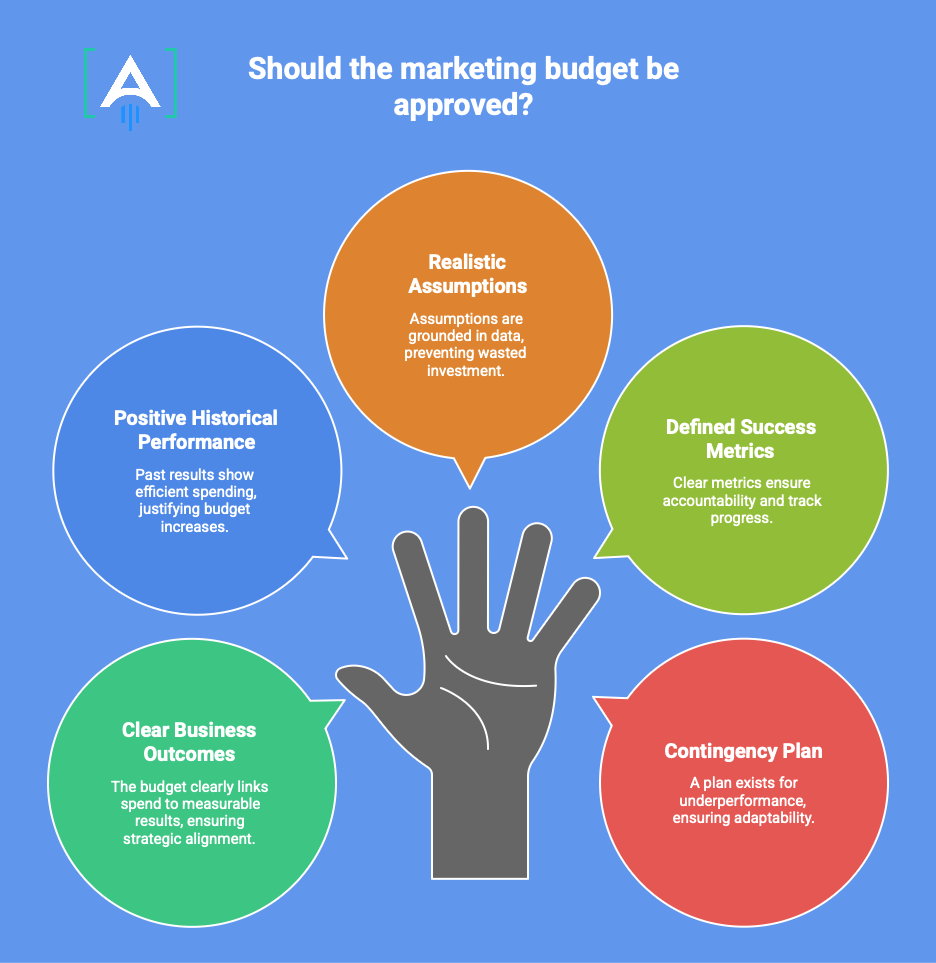
Question 1: What Specific Business Outcomes Will This Budget Deliver?
Demand a clear connection between proposed spend and measurable business results. Vague answers about brand awareness or engagement indicate a weak strategy.
Acceptable Answers Include:
- Specific customer acquisition targets by channel
- Pipeline contribution goals with attribution methodology
- Revenue targets with a clear path from marketing activity
- Market share objectives tied to competitive positioning
Reject proposals that fail to tie specific outcomes to your growth goals.
Question 2: How Does This Compare To Historical Performance?
Review prior marketing results before increasing investment. Bigger budgets should align with better results, not worse.
Examine customer acquisition costs, marketing-sourced revenue percentage, and ROI by channel over the past 12 months. Budget increases make sense when historical data shows efficient spending. Flat or growing CAC with budget increases indicates problems.
Question 3: What Assumptions Underpin This Budget?
Marketing budgets rely on assumptions about conversion rates, lifetime value, the market, and competitors. Make these explicit.
Challenge optimistic assumptions that lack historical grounding. Ask what happens if key assumptions prove 20% to 30% wrong. Budgets built on unrealistic assumptions waste money chasing unattainable targets.
Question 4: How Will Success Be Measured?
Set clear success metrics and reporting cadence before approval. Without defined measures, you can’t ensure accountability.
Insist on business outcome metrics like CAC, ROI, pipeline, and revenue attribution. Activity metrics such as impressions or engagement don’t prove value.
Question 5: What’s The Contingency Plan?
Markets change, and campaigns underperform. Ask how the marketing team will respond if results fall short of projections.
Strong answers include reallocation plans, criteria for cutting underperforming channels, and triggers for strategy adjustments. Weak answers signal hope over planning.
The Risk Assessment Framework
Evaluate budget proposals against three risk factors.
Execution Risk
Can your team actually execute the proposed strategy? Ambitious plans mean nothing without the capability to deliver.
Risk Factors:
- Skill gaps in critical areas
- Unproven tactics requiring expertise you lack
- Capacity constraints limit execution quality.
- Technology requirements are not yet in place
High execution risk calls for small initial budgets, with increases as capability grows.
Market Risk
External factors shape marketing outcomes. Assess market risk honestly before committing funds.
Honestly, before committing resources.
Consider changes in competitive intensity, economic conditions affecting buyer behavior, regulatory shifts impacting tactics, and platform algorithm changes disrupting channel performance.
Attribution Risk
If you can’t measure it, you can’t manage it. Weak attribution hides waste.
Question whether proposed measurement systems can actually track results. Insist on a clear attribution methodology before approving significant spend in channels with attribution challenges.
Red Flags That Should Pause Approval
Certain warning signs indicate that budget proposals need more work before approval.
Critical Red Flags:
- Inability to explain strategy in simple business terms
- Historical underperformance without clear corrective actions
- Excessive focus on tactics versus outcomes
- Resistance to clear success metrics and accountability
- Assumptions disconnected from market reality
Send proposals with these flags back for revision instead of approving weak budgets.
Conclusion: Approval Framework For CEO Marketing
Marketing budget approval significantly impacts growth and resource use. With 61% of marketing leaders facing more CEO scrutiny, clear frameworks help avoid waste while supporting necessary investments. Begin with industry benchmarks. Ask the five critical questions about outcomes, historical performance, assumptions, measurement, and contingency planning. Evaluate execution, market, and attribution risk before committing resources.
Many CEOs find value in bringing growth marketing agencies into the approval process. Agencies provide objective external assessment of proposed budgets and strategies. They identify unrealistic assumptions, suggest more efficient allocation, and bring cross-company benchmarks that inform better decisions.
Working with a growth partner like [A] Growth Agency can make the budget approval process far more effective. They bring an outside perspective, helping CEOs see where assumptions may be overly optimistic and where resources could be better allocated.
By applying proven frameworks and cross-industry benchmarks, they turn complex proposals into clear, actionable insights. This ensures marketing investments are realistic, measurable, and aligned with business goals.
Need an objective assessment of your marketing budget proposal?
Get expert evaluation that avoids politics and gives clear answers on what works.

