


Most business owners know their marketing isn’t performing optimally. Conversion rates disappoint, customer acquisition costs climb, and campaigns fail to deliver expected returns. The default response is to hire expensive consultants who promise comprehensive audits and strategic recommendations for fees ranging from $5,000 to $25,000.
30% of small businesses say lead generation is their #1 marketing obstacle, ahead of budget issues. This struggle often stems from fundamental marketing gaps that business owners can identify and fix themselves without consulting fees. The marketing audit for business owners doesn’t require specialized expertise or expensive tools.
You need systematic frameworks for evaluating what’s working, identifying what’s broken, and prioritizing fixes based on potential impact. The process takes 10 to 15 hours spread over a week, but delivers clarity worth tens of thousands of dollars in consultant fees. Understanding how to conduct your own assessment saves money while building marketing knowledge that serves your business long-term.
Before diving into the specifics, it’s important to understand why many business owners hesitate to audit their own marketing efforts in the first place.
Why Most Business Owners Avoid Marketing Audits
The marketing audit for business owners gets postponed indefinitely despite its importance. Business owners recognize that marketing performance leaves room for improvement, but resist systematic evaluation for predictable reasons.
The perceived complexity intimidates owners who aren’t marketing experts. The audit sounds technical and overwhelming. You imagine spreadsheets full of incomprehensible metrics and analyses that require specialized knowledge you don’t possess.
Fear of discovering major problems also creates avoidance. If an audit reveals that your entire approach is fundamentally flawed, you’ll face uncomfortable decisions about changing strategies mid-year. Ignoring performance allows you to maintain comfortable assumptions.
Time constraints are a frequent reason for avoiding marketing audits; running a business leaves little room for what feels like a non-urgent task.
These barriers are mostly psychological. Marketing audits require time but not specialized knowledge. The process is simple and the insights valuable.
Avoiding audits costs more than conducting them. Poor marketing wastes budget on ineffective channels. Missed opportunities compound monthly. Small fixable issues become major strategic problems when ignored for quarters or years.
What a Marketing Audit for Business Owners Actually Examines
A comprehensive marketing audit for business owners follows a clear six-step sequence. Each step covers a core area requiring individual analysis using different frameworks and metrics.
Customer Acquisition Economics
Customer acquisition economics determine whether your marketing is fundamentally profitable or losing money. Many businesses invest in marketing without understanding basic unit economics that reveal sustainability.
Break down CAC by acquisition channel to identify which marketing investments deliver efficient returns:
- Organic search and content marketing typically show lower CAC than paid channels.
- Referral programs often deliver the lowest CAC once established.
- Paid advertising CAC varies dramatically by platform and targeting.
- Event marketing usually shows the highest CAC, but sometimes the highest LTV.
Track the payback period to show how long it takes the marketing investment to return. Shorter payback periods allow faster reinvestment in growth. Calculate by dividing CAC by average monthly revenue per customer.
Channel Performance and Attribution
Channel performance analysis reveals which marketing activities actually drive results versus which consume budget without meaningful contribution. Most businesses spread effort across too many channels without understanding relative performance.
Review each active marketing channel systematically. List every channel where you invest time or money, including organic search, paid search, social media organic and paid, email marketing, content marketing, events and webinars, partnerships and referrals, and direct outreach.
For each channel, document monthly investment in dollars and hours. Calculate the number of leads generated, conversion rates, and customer acquisition cost. This creates comparable metrics showing relative efficiency across channels.
Attribution becomes critical for understanding how channels work together. First-touch attribution shows which channels generate initial awareness. Last-touch attribution reveals what closes deals. Multi-touch models distribute credit across the entire customer journey.
Organizations that implement data analytics and reporting capabilities can accurately track attribution. Without sophisticated systems, use simple proxy metrics, such as asking new customers how they found you during onboarding.
Common findings from channel audits include spreading the budget too thin across many mediocre channels instead of concentrating on winners, continuing investment in legacy channels based on past performance rather than current results, missing attribution for organic channels that appear free but require significant time investment, and neglecting channels that could perform well with proper optimization and budget allocation.
Content and Messaging Effectiveness
Content and messaging determine whether your marketing resonates with target audiences or gets ignored. Audit both the strategic positioning and tactical execution of your content across channels.
Start with a strategic message audit. Document your current value proposition, differentiation claims, and key messages. Write down exactly what you tell prospects about why they should choose you.
Analyze content performance using engagement metrics and business outcomes:
- Website pages: traffic, time on page, bounce rate, conversion rate
- Blog posts: organic traffic, social shares, backlinks, lead generation
- Email campaigns: open rates, click rates, conversion to meetings or purchases
- Social media: engagement rates, profile visits, link clicks, conversions
Organizations investing in AI marketing agency capabilities can accelerate content production while maintaining quality. This allows you to fill gaps identified during audits without proportionally increasing team size or budget.
Brand Presence and Competitive Positioning
Brand presence determines whether your target market knows you exist and considers you during purchase decisions. Competitive positioning reveals whether you’ve clearly differentiated from alternatives or blend into commodity competition.
Audit your owned properties starting with website quality, mobile responsiveness, page load speed, SEO optimization, clear value proposition, and conversion optimization. Your website often forms first impressions. Technical issues, unclear messaging, or poor user experience cost opportunities daily.
Evaluate social media marketing presence across relevant platforms. Assess follower growth rates, engagement rates on posts, consistency of posting schedule, alignment with brand voice, and conversion from social to website or leads. Many businesses maintain social presence out of obligation rather than strategic intent, posting irregularly without driving measurable business outcomes.
Assess review presence and ratings across Google, industry-specific platforms, and general review sites. Reviews impact buyer decisions significantly. Low volume or poor ratings require systematic improvement through customer success initiatives and review generation programs.
Organizations working with branding agency partners often discover positioning gaps through competitive analysis. External perspective reveals how the market actually perceives you versus how you perceive yourself.
How to Conduct Your Marketing Audit for Business Owners
The systematic process for conducting a marketing audit for business owners follows a structured sequence. Skip steps, and you’ll miss critical issues or waste time on low-impact areas.
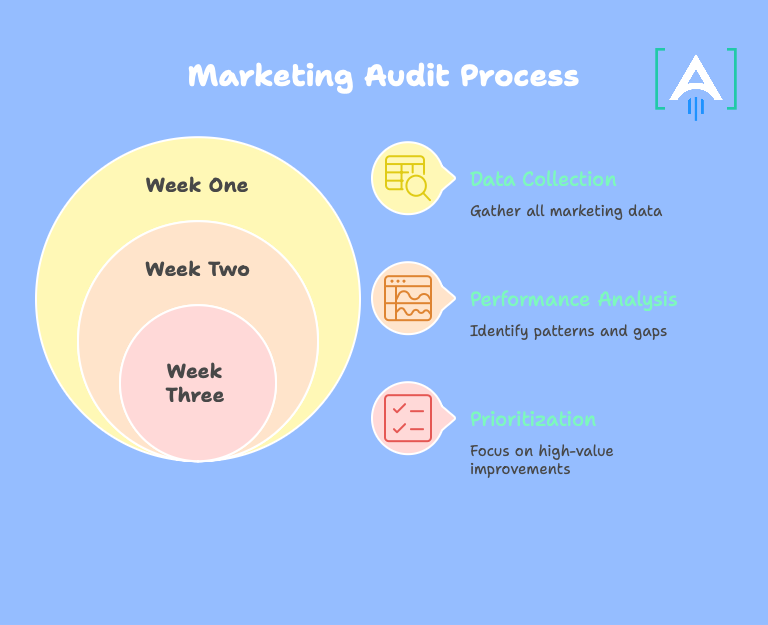
Week One: Data Collection and Baseline Metrics
Begin by gathering all existing marketing data into one location. This centralization enables analysis and reveals which data you’re actually tracking versus what you should track.
Document current marketing activities comprehensively:
- Content production: blog posts published, social updates, email sends
- Advertising: platforms used, budget allocation, campaign types
- Events: conferences attended, webinars hosted, speaking engagements
- Partnerships: affiliate relationships, co-marketing initiatives, referral programs
This inventory reveals where you’re actually investing time and money. Many business owners discover they’ve assumed certain activities were happening consistently when execution has been sporadic or stopped entirely.
Week Two: Performance Analysis and Gap Identification
Analyze the data collected during week one to identify patterns, trends, and gaps. This analysis transforms raw data into actionable insights about what’s working and what needs fixing.
Start with channel ROI analysis. For each marketing channel, calculate leads generated, customer acquisition cost, customers acquired, revenue generated, and return on investment. Rank channels from highest to lowest ROI to identify winners and losers.
Examine conversion funnel performance at each stage. Calculate drop-off rates and identify your biggest bottleneck. Model the revenue impact if you improved each stage’s conversion rate by 10 %. This quantification guides prioritization.
Review content performance, sorting by various metrics. Identify your top-performing pieces by organic traffic, conversion rate, and business impact. Analyze what made them successful compared to underperforming content.
Create a comprehensive gap list documenting every issue identified:
- Performance gaps: metrics below targets or benchmarks
- Capability gaps: marketing you should do but currently don’t
- Resource gaps: budget, tools, or team capacity constraints
- Knowledge gaps: skills or expertise your team lacks
- Process gaps: missing systems or documented workflows
This gap list becomes your roadmap for improvements. The audit identifies problems. Implementation fixes them systematically over subsequent months.
Week Three: Prioritization and Action Planning
Not all gaps deserve equal attention. Prioritize based on potential business impact and implementation difficulty to focus on the highest-value improvements first.
Document quick wins that can be implemented immediately with minimal resources. These might include fixing broken tracking code, updating outdated website content, pausing underperforming ad campaigns, or redistributing budget from low-ROI to high-ROI channels.
Organizations often discover through self-audits that they need support in specific areas as they pursue other internal improvements. Working with focused specialists on high-impact initiatives often delivers better results than hiring generalist consultants.
Common Findings From Marketing Audits
Many small businesses try to market across 6 to 10 channels at the same time, without enough budget or team capacity to support any single one properly. This spreads resources too thin and creates the illusion of comprehensive marketing, while preventing real traction in any channel.
Typical pattern
• $500 per month on Google Ads
• $300 on Facebook advertising
• $200 on LinkedIn ads
• Minimal effort across Twitter, Instagram, and Pinterest
• Inconsistent blog publishing
• Sporadic email campaigns
None of these investments reach the threshold required for meaningful results.
When budgets are fragmented like this, teams cannot test properly, optimize effectively, or scale what works. Each channel underperforms not because it is ineffective, but because it is underfunded and under-executed.
Concentration consistently outperforms diversification in small business marketing. Allocating the same total budget to just two or three channels allows for proper testing, optimization, and sustained execution. Results improve dramatically when channels are executed well rather than attempted superficially.
Tracking Activity Instead of Outcomes
Many marketing teams measure what is easy to track instead of what actually impacts the business. Activity metrics create the appearance of productivity without proving effectiveness.
Common activity metrics
• Social media posts published per week
• Blog articles published per month
• Number of emails sent
• Advertising impressions or reach
These metrics show that marketing activity exists, but they do not answer whether it is driving results.
Outcome metrics connect marketing efforts directly to business performance.
Outcome-focused metrics
• Leads generated by channel
• Customer acquisition cost by source
• Conversion rates throughout the funnel
• Marketing-influenced revenue
• Return on marketing investment
Shifting from activity metrics to outcome metrics requires better tracking and attribution, but it fundamentally changes marketing effectiveness. Teams that optimize for outcomes naturally prioritize work that drives revenue instead of work that merely looks busy.
Missing or Broken Attribution
Without proper attribution, businesses cannot determine which marketing efforts actually drive customers and which simply receive credit by coincidence. This makes budget allocation and optimization nearly impossible.
Most small businesses rely on last-touch attribution, assigning all credit to the final interaction before purchase. This approach undervalues awareness and consideration-stage marketing that creates initial interest and builds trust over time.
Improved attribution involves tracking the full customer journey from first touch to conversion. Marketing automation platforms, CRM systems, and analytics tools support multi-touch attribution. Even simple steps, such as asking customers how they found you during onboarding, can provide valuable directional insight.
Organizations that implement better attribution often discover that channels previously considered underperforming play a critical role early in the buyer journey. At the same time, channels credited with conversions frequently benefit from earlier awareness efforts they did not create themselves.
Neglecting Retention and Expansion
Small business marketing efforts are often focused almost entirely on new customer acquisition, while retention and expansion opportunities are overlooked. This leaves significant revenue potential untapped.
Audit findings frequently reveal:
• Little or no post-purchase email communication
• No structured upsell or cross-sell programs
• A lack of customer success content or education
• No referral programs to encourage advocacy
Retention economics almost always outperform acquisition economics. Selling to existing customers costs less, converts at higher rates, and often results in higher average order values. Improving retention also increases customer lifetime value, making acquisition efforts more profitable over time.
Inconsistent or Abandoned Initiatives
Marketing audits often uncover a pattern of started but abandoned initiatives.
Common examples include blogs that have not been updated in months, social media accounts with sporadic posting, email nurture sequences that stop mid-way, or webinar programs that ran once and never returned.
This usually happens when tactics are launched without commitment to sustained execution. Most marketing channels do not deliver immediate results. They require consistent effort over months before performance improves.
Business owners juggling multiple responsibilities often deprioritize marketing when time gets tight. Initial enthusiasm fuels the launch, but daily operational demands pull focus away.
Audit recommendations typically emphasize choosing fewer initiatives and committing to consistent execution. One well-maintained channel will almost always outperform five that are launched and abandoned.
What to Do After Completing Your Marketing Audit
A marketing audit only creates value when its findings lead to better performance. Without implementation, even the most detailed analysis becomes wasted effort. The difference between insight and impact is execution.
Create Your 90 Day Implementation Plan
Audit findings should translate into specific, actionable steps with clear ownership, timelines, and success metrics. Vague intentions like improving SEO or doing more email marketing rarely produce change without concrete plans.
Start by selecting three to five immediate priorities from your gap analysis. Focus on improvements with the highest impact relative to effort, and that are realistic given your current resources. Trying to fix everything at once usually leads to stalled execution.
For each priority, define exactly what success looks like. Outcomes should be specific and measurable. For example, improving conversion rate becomes increasing demo request conversion from 2 percent to 3.5 percent within 90 days. Specific goals enable tracking and accountability.
Assign clear ownership for every initiative. Identify who is responsible for completing the work, when they will work on it, and which responsibilities may need to shift to create capacity. Implementation often fails when ownership is shared too broadly and no one is truly accountable.
Document any required resources, budget, or external support. If execution depends on tools you do not have, budget that is not allocated, or expertise your team lacks, those prerequisites must be addressed before work begins.
Schedule monthly review sessions to evaluate progress against the 90 day plan. Measure whether initiatives are delivering target outcomes, identify obstacles slowing progress, and adjust tactics based on what you learn during implementation.
Fix Quick Wins Immediately
Every marketing audit uncovers issues that can be fixed within days and improve performance immediately. Address these quick wins before launching larger strategic initiatives.
Common quick wins
• Pausing underperforming ad campaigns that waste budget
• Fixing broken tracking code that prevents accurate attribution
• Updating outdated website content that harms credibility
• Correcting technical SEO issues that block indexing
• Redistributing budget from low ROI to high ROI channels
Quick wins create momentum and demonstrate the value of the audit. Immediate improvements build confidence and motivation, while eliminating waste frees up budget and resources for larger initiatives.
Do not delay quick wins in pursuit of perfect long-term solutions. If you discover that a significant portion of ad spend is generating negative returns, pause those campaigns immediately. Strategy refinement can come later, but waste should stop as soon as it is identified.
Establish Ongoing Measurement
A one-time audit provides a snapshot, not sustained improvement. Ongoing measurement systems are essential for maintaining visibility into marketing performance over time.
Build a marketing dashboard that tracks key performance indicators such as monthly leads by source, customer acquisition cost by channel, funnel conversion rates, marketing-influenced revenue, and return on marketing investment. Update this dashboard monthly and review it with relevant stakeholders.
Set up automated reporting across your marketing tools. Platforms like Google Analytics, advertising networks, email providers, and CRM systems allow scheduled reporting. Configure monthly summaries to be delivered automatically, reducing manual effort and ensuring consistency.
Schedule quarterly mini audits to reassess performance, identify new gaps, and update priorities. These reviews require significantly less time than a full audit but help maintain momentum and prevent performance decline over time.
Organizations working with growth marketing agencies often maintain self-audit practices while leveraging external expertise for implementation and optimization. This combination provides accountability and execution capacity while building internal marketing knowledge.
When to Hire Help Despite DIY Capability
The marketing audit for business owners can be done entirely without consultants. Implementing audit findings sometimes benefits from specialized expertise you don’t have internally.
Recognize when you’ve identified issues requiring skills or tools you don’t have. Technical SEO improvements, marketing automation implementation, paid advertising optimization, or advanced analytics setup might justify external support even when you completed the audit yourself.
Consider opportunity cost honestly. Can you implement findings faster by doing it yourself or by hiring experts? If implementation requires 100 hours of learning and execution, but experts could complete it in 20 billable hours, the math favors hiring even at premium rates.
Evaluate ongoing versus project-based needs. One-time implementations, such as CRM setup or website redesign, are well-suited to project-based hiring. Ongoing needs such as content production, advertising management, or social media might justify retaining services or hiring internally.
Many successful approaches combine DIY audits with selective hiring. You assess your own marketing to identify issues and prioritize opportunities. You then engage specialists for high-impact implementations requiring expertise you lack while handling other improvements internally.
At Azarian Growth Agency, we work with business owners who’ve completed their own marketing audits and identified specific needs.
Our focused approach provides content marketing, AI marketing, data analytics, and strategic implementation support. This model gives you the control and cost savings of DIY assessment with expert execution on priorities you’ve defined.
The marketing audit for business owners is an essential discipline, whether or not you ultimately hire implementation help. Understanding what’s working and what needs fixing allows intelligent decisions about resource allocation, whether those resources come from internal teams, contractors, or agency partners.
Ready to move from marketing assessment to measurable improvement?
Partner with us to implement your audit findings with experts who focus on business outcomes, not billable hours.

