


Search behavior is shifting dramatically from Google-first to AI-first, and AI SEO tools are starting to become more important. Business owners now face a new reality called Generative Engine Optimization. This isn’t just a trend. It’s a fundamental change in how customers discover brands.
Nearly three-quarters of the industry is adapting to AI-driven search. The shift happened fast. ChatGPT reached 800 million weekly users by October 2025, doubling from 400 million in just eight months.
Free AI SEO tools help you research keywords and explore opportunities. Paid platforms help you actually rank. The difference matters more than ever as AI-generated search results dominate user experiences.
Here’s the challenge founders face today. Traditional SEO focused on keyword rankings. Modern SEO requires semantic optimization, technical automation, and visibility in AI-generated answers. Free tools handle basic tasks. Paid tools deliver the advanced capabilities that move rankings.
This guide reveals which AI SEO tools produce measurable results in 2026. You’ll discover when free platforms suffice and when paid tools become essential. You’ll learn how Generative Engine Optimization changes everything about search visibility. And you’ll see exactly how working with an SEO agency accelerates growth faster than DIY approaches alone.
The future of search is here. Let’s explore how to win in this new landscape.
What AI SEO Tools Actually Do Today
AI SEO tools now support every stage of modern search visibility, from keyword research to technical audits to content optimization. These platforms use machine learning to analyze search patterns, competitor strategies, and ranking factors at scale.
The capabilities extend far beyond basic keyword suggestions. Modern AI-powered tools handle semantic analysis, cluster related topics, predict ranking difficulty, and even optimize for Generative Engine responses. This represents a massive leap from traditional SEO software.
Here are the core tasks founders automate with AI SEO tools today:
- AI keyword clustering: Groups related terms into topical themes for comprehensive content coverage
- SERP analysis: Evaluates what’s currently ranking and identifies content gaps you can exploit
- Content optimization: Scores your drafts against top-ranking pages and suggests improvements
- Semantic SEO and GEO: Optimizes content for both traditional search and AI-generated answers
- Link-building automation: Identifies prospects, analyzes competitor backlinks, and manages outreach
- Technical SEO audits: Crawls sites to find broken links, duplicate content, and speed issues
According to data from Marketing LTB, 31% of marketers now use generative AI extensively in SEO, with another 25% using it partially. That’s over half of all marketers integrating AI into their search optimization workflows.
The rise of GEO tools reflects how search is evolving. Research shows AI-referred sessions jumped 527% in the first half of 2025. When ChatGPT or Perplexity answers a query without sending users to traditional search results, you need optimization strategies that get your brand cited in those AI responses.
Understanding these capabilities is crucial. The tools exist. But knowing which ones deliver real ranking improvements requires deeper analysis of both free and paid options.
Free AI SEO Tools (2026)
1. Google Gemini

Google’s free AI assistant has become a popular starting point for AI content optimization, outline creation, and early-stage keyword ideation. While it is not a full GEO tool, it helps creators structure long-form content and refine clarity, which indirectly supports rankings.
Advantages
- Free and accessible
- Generates long-tail keyword ideas
- Great for summaries, structure, and semantic clarity
Disadvantages
- No technical SEO automation
- No GEO visibility tracking
- Not built for competitive analysis
Best Use Cases
Early drafts, topic clustering, expanding content briefs, and assisting with SEO AI assistants.
Service Type
Free generative AI for research and content shaping.
2. ChatGPT Free
ChatGPT’s free tier remains highly effective for rewriting, keyword clustering, and generating AI content briefs. It’s widely used by creators needing fast, flexible SEO help.
Advantages
- Strong rewriting for SEO content
- Helps uncover long-tail keywords
- Great for SERP analysis through prompting
Disadvantages
- No built-in GEO tools
- No automated technical SEO audits
- Can produce outdated suggestions unless guided
Best Use Cases
Content expansion, brainstorming, and turning raw ideas into SEO-optimized formats.
Service Type
Free AI assistant for writing and optimization.
3. HubSpot AI Search Grader
This free diagnostic tool grades your content for AI search performance and GEO readiness.
Advantages
- Free GEO assessment
- Evaluates semantic structure
- Fast snapshot of AI search readiness
Disadvantages
- Not a full AI keyword research tool
- Lacks continuous tracking
Best Use Cases
Initial GEO evaluation and understanding how AI models interpret your site.
Service Type
Free AI search readiness report.
4. ProductRank.ai
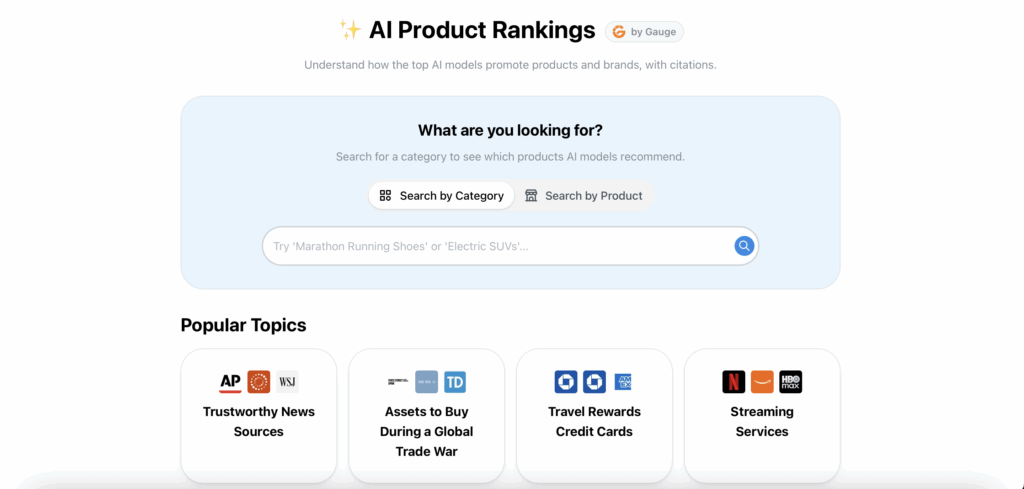
A free way to check how LLMs describe your brand across ChatGPT, Claude, Gemini, and Perplexity.
Advantages
- Multi-model AI visibility checks
- Instant snapshot of brand perception
- Completely free
Disadvantages
- Not a comprehensive SEO platform
- No backlink prospecting automation or content scoring
Best Use Cases
Quick LLM checks, first step in understanding AI brand visibility.
Service Type
Free AI search checker.
5. Yoast SEO Free
A WordPress plugin offering basic AI-assisted readability
and schema, helpful for semantic SEO.
Advantages
- Automated schema markup
- Basic AI readability suggestions
- Good for beginners using WordPress
Disadvantages
- Not built for GEO
- No LLM visibility tracking
- Limited AI features
Best Use Cases
Entry-level semantic SEO enhancement and content formatting.
Service Type
Free WordPress SEO tool with light AI enhancements.
Paid AI SEO Tools (2026)
1. Surfer SEO

A leading platform for AI content optimization that now includes GEO-ready structures, NLP scoring, and keyword expansion powered by AI. Surfer helps content creators build pages that perform well in both traditional SERPs and generative engines.
Advantages
- Strong SEO + AI optimization blend
- GEO-optimized content guidelines
- Excellent SERP analysis AI features
Disadvantages
- Expensive for small creators
- AI writing requires higher plans
Best Use Cases
High-performance content writing, SEO briefs, and preparing pages for generative engine optimization tools in 2025-2026.
Service Type
Paid plans starting at 99/month.
2. Clearscope
A premium AI content optimization platform known for semantic depth and enterprise-level scoring.
Advantages
- World-class semantic optimization
- Helps content rank higher in both Google and AI models
- Clean UI and dependable scoring
Disadvantages
- Very expensive
- No GEO visibility tracking
Best Use Cases
Enterprise teams produce long, authoritative content with high competition.
Service Type
Plans from 199/month.
3. MarketMuse
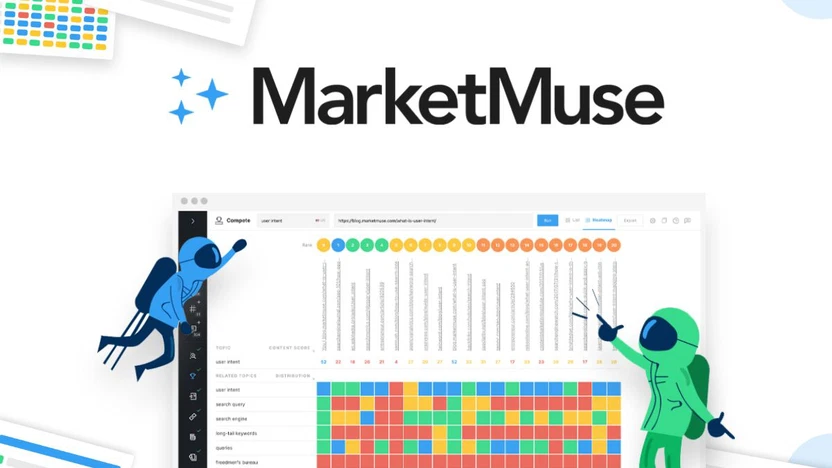
An advanced AI keyword research tool with topic modeling, entity optimization, and deep planning capabilities.
Advantages
- Best-in-class topic modeling
- Entity-driven SEO
- Exceptional for long-form content strategy
Disadvantages
- Requires onboarding
- Built for enterprise complexity
Best Use Cases
Enterprise SEO platform comparison, detailed content planning, and entity-centric optimization.
Service Type
Plans start at 149/month.
4. Frase
A budget-friendly tool for AI content briefs, question research, and SERP analysis AI.
Advantages
- Very affordable
- Excellent question + intent research
- Useful for beginners creating optimized briefs
Disadvantages
- Less powerful than MarketMuse or Clearscope
- Basic NLP capabilities
Best Use Cases
Small teams needing fast and inexpensive AI-powered briefs.
Service Type
Plans from 15/month.
5. InLinks
A semantic SEO tool focused on internal linking and entity optimization.
Advantages
- Strong entity-based SEO
- Automated internal linking
- Great for large content libraries
Disadvantages
- Complicated setup
- Not suitable for beginners
Best Use Cases
Entity-heavy sites, publishers, and teams prioritizing semantic structure.
Service Type
Plans from 39/month.
6. NeuronWriter

A budget alternative for AI content optimization, using NLP to improve semantic alignment.
Advantages
- Very affordable
- Solid NLP scoring
- Good for long-tail keyword expansion
Disadvantages
- Not enterprise-grade
- Interface feels dated
Best Use Cases
Bloggers and small businesses seeking budget AI SEO tools.
Service Type
Plans from 23/month.
7. WordLift
A semantic SEO and AI knowledge graph builder that prepares websites for future AI search.
Advantages
- Knowledge graphs and schema enrichment
- Strong semantic linking
- Improves AI-driven visibility significantly
Disadvantages
- Can be expensive at scale
- Requires setup and structure
Best Use Cases
Websites aiming for deep semantic SEO, AI-ready structure, and enterprise-style optimization.
Service Type
Plans from €49/month.
8. SE Ranking AI Add-on
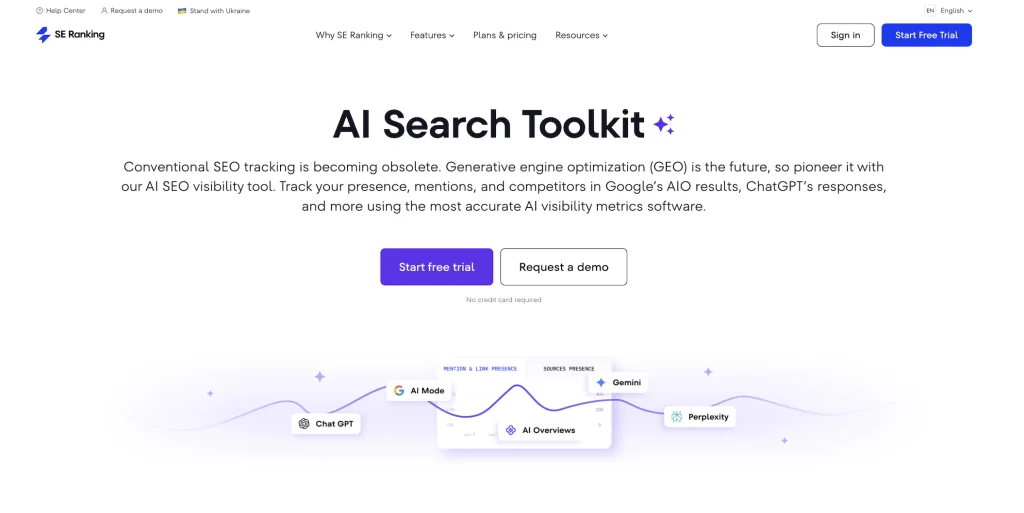
A hybrid SEO suite offering GEO tracking for Google AI Overviews, ChatGPT results, and Claude responses.
Advantages
- Tracks AI search relevance
- Part of a full SEO platform
- Strong competitor tracking
Disadvantages
- AI features cost extra
- Not a specialized GEO tool
Best Use Cases
Marketing agencies and teams wanting AI + traditional SEO in one dashboard.
Service Type
Platform from 65/month + AI search add-on.
ROI Example: When Paid Tools Produce Tangible Ranking Lifts
The return becomes clear in specific scenarios. Paid platforms are worth the investment when you need fast and measurable ranking improvements.
For example, one client upgraded from free tools to a paid stack using Surfer and Ahrefs. Within four months, they achieved results that free tools had never delivered. Paid tools helped them optimize for the factors that matter most, as 62% of B2B marketers claim that SEO algorithms are important. Organic traffic grew 40% as optimized pages began ranking, and they gained 60 new keywords in page one positions.
HubSpot’s data supports these outcomes. They report that marketers using AI create content more efficiently. Among those using paid platforms specifically, 68% report positive ROI on productivity and effectiveness.
Paid tools aren’t magic. But when your SEO strategy is sound and execution is the bottleneck, they compress timelines dramatically. The investment pays for itself when ranking improvements drive qualified traffic that converts.
Free Vs Paid AI SEO Software: The Six Differences Founders Must Care About
Free vs paid AI SEO software differs across dimensions that directly impact your ability to rank. Understanding these gaps helps you decide when upgrading makes strategic sense.
Data accuracy: Free tools use estimated or sampled data. Paid platforms access real search volumes, actual click-through rates, and verified backlink profiles. This accuracy determines whether your keyword targeting succeeds or wastes time.
Depth of competitive analysis: Free versions show surface-level competitor data. Paid tools reveal exact keywords competitors rank for, which pages drive their traffic, and how their backlink profiles have developed over time. This intelligence shapes winning strategies.
Technical SEO automation: Free tools require manual site audits. Paid platforms crawl your entire site automatically, flag issues immediately, and monitor changes continuously. This automation prevents ranking drops before they happen.
GEO optimization: Free tools lack features for optimizing content to appear in AI-generated search results. Paid platforms help you structure content for citation in ChatGPT responses, Google AI Overviews, and Perplexity answers. According to research from Frase.io, content with proper schema markup shows 30-40% higher AI visibility.
Backlink prospecting automation: Free tools might identify some link opportunities. Paid systems automate prospect discovery, contact finding, outreach personalization, and relationship tracking. This scales link building from a side project to a systematic growth channel.
Team collaboration: Free tools work for solo founders. Paid platforms support multiple users with shared dashboards, reporting, and workflow management. You can scale your SEO operation without switching tools.
The founder takeaway is clear. Free tools support learning and exploration. Paid tools deliver the infrastructure required for systematic ranking improvements. If SEO is a minor experiment, free suffices. If organic search drives business growth, paid tools become essential infrastructure.
The gap widens in competitive markets. Three target keywords with low competition? Free tools might work. Thirty keywords against established competitors? You need paid capabilities to compete effectively.
Framework: How To Know If It’s Time To Upgrade Your AI SEO Workflow
Deciding when to upgrade your AI SEO workflow isn’t always obvious. These signals indicate when paid tools will actually improve your results and justify the investment.
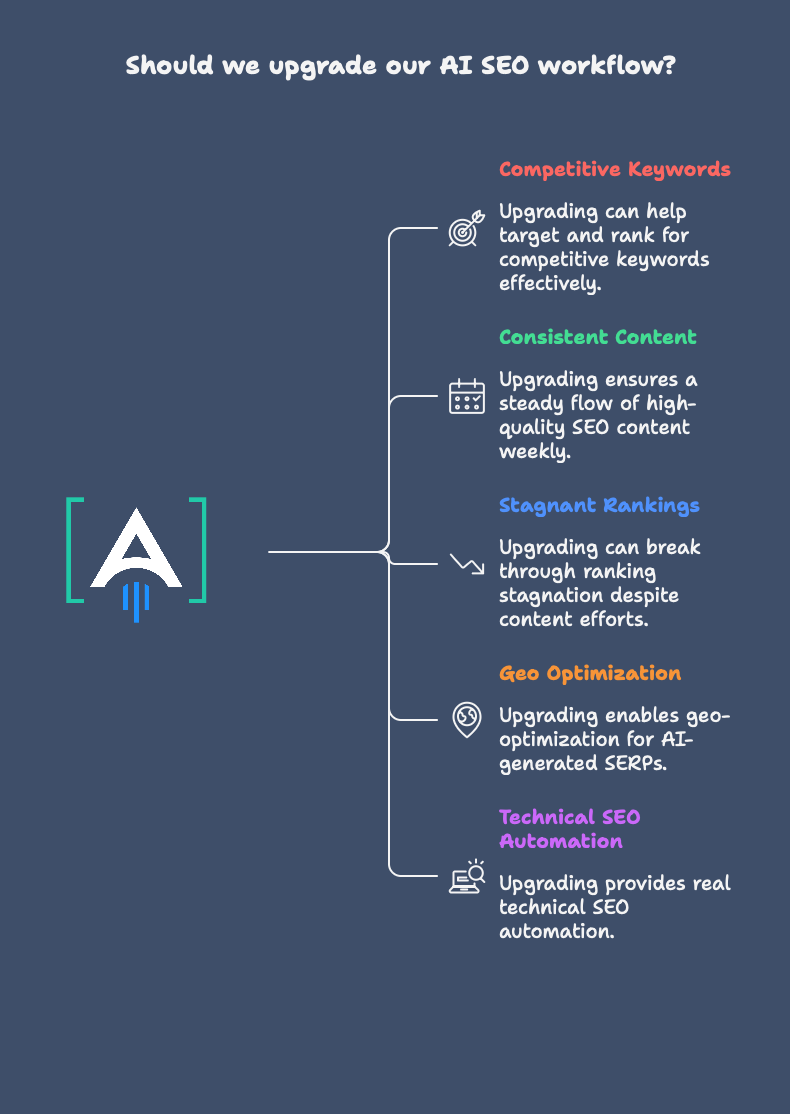
You’re Targeting Competitive Keywords
Once you move beyond low-competition long-tail terms, free tools fall short. Competitive keywords require a deep analysis of what’s already ranking. You need to understand competitor content depth, backlink profiles, and technical optimization. Paid platforms provide this intelligence. Free tools show you the competition exists, but not how to beat it.
You Need Consistent High-Quality SEO Content Weekly
Publishing one optimized article monthly? Free tools suffice. Creating 4-8 SEO-focused pieces weekly? You need automation. Paid AI content optimization platforms generate detailed briefs, score drafts against competitors, and suggest improvements in real time. This removes the manual research bottleneck that limits output.
Your Rankings Are Stagnant Despite Content Production
If you’re publishing consistently but rankings aren’t improving, you likely have an optimization problem. Free tools can’t diagnose why the content isn’t ranking. Paid platforms analyze your pages against top results, identify gaps in topical coverage, and reveal technical issues holding you back.
You Need GEO Optimization For AI-Generated SERPs
AI Traffic Report, AI-referred sessions jumped 527% in the first half of 2025. When users ask ChatGPT or Perplexity questions instead of searching Google, traditional rankings matter less. Paid tools help you structure content for citation in these AI responses. Free tools ignore GEO entirely.
You Need Real Technical SEO Automation
Manual technical audits catch obvious issues but miss subtle problems. Paid platforms crawl your site automatically, monitor for broken links, track page speed, and alert you to indexing problems before they impact rankings. This continuous monitoring prevents the ranking drops that cost traffic and revenue.
Here’s a quick upgrade readiness checklist:
- Targeting keywords with significant competition
- Publishing 4+ SEO-focused pieces weekly
- Current rankings are flat despite consistent effort
- Need visibility in AI-generated search results
- Technical issues impacting site performance
- Managing SEO across multiple team members
If you checked three or more boxes, upgrading will likely improve both efficiency and results. Partnering with a data-driven agency can help you implement these tools correctly and extract maximum value from your investment.
The Hidden Costs Of Staying On Free AI SEO Tools
Free AI SEO tools appear cost-effective until you calculate what they actually cost in lost opportunities and wasted effort. These hidden expenses compound quickly.
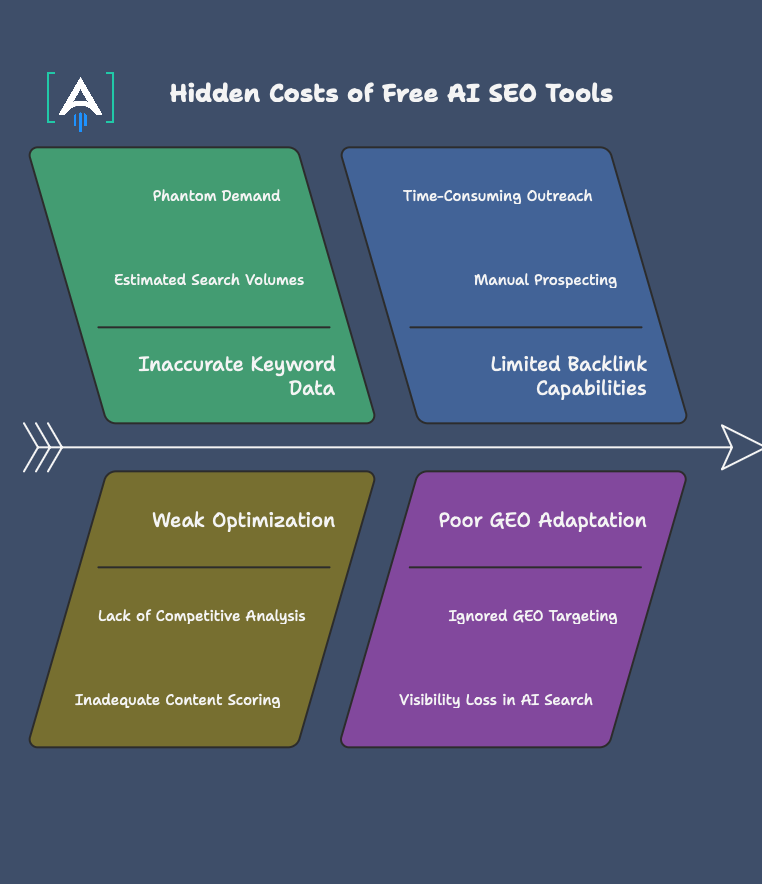
Wrong keyword data: Free tools often show estimated rather than actual search volumes. For example, you might target keywords with phantom demand or ignore high-potential terms with inaccurate data. As a result, every piece of content targeting the wrong keyword wastes weeks of effort.
Moreover, weak optimization can lead to lower rankings. Without proper competitive analysis and content scoring, your pages rank worse than they should. According to research from First Page Sage, the top 3 search results capture 54.4% of all clicks. Therefore, missing these positions means losing the majority of available traffic.
In addition, free tools lack backlink capabilities. They can’t execute link building at scale. Consequently, you’re stuck with manual prospecting and outreach. At 5 hours weekly on link building, that’s 260 hours annually that automation could handle better.
Furthermore, time is lost doing manual audits. Without automated technical monitoring, issues go undetected until they damage rankings. For instance, one client lost 30% of their traffic to an indexing problem that took weeks to discover. Meanwhile, paid tools would have flagged it immediately.
Poor GEO adaptation can also cause visibility loss in AI search. Specifically, research from dataslayer.ai shows AI Overviews now appear in 20% of Google searches as of September 2025. Consequently, content not optimized for AI citation loses visibility in this growing channel. Additionally, free tools ignore GEO entirely.
According to Insider Intelligence data on marketing efficiency, teams lose an average of 8 hours weekly on manual tasks that automation could handle. Over a year, that’s 416 hours per person. Similarly, for a three-person team, that’s 1,248 hours annually spent on work that paid tools would automate.
Ultimately, free tools work for learning. However, staying on them too long creates invisible drag on your entire SEO operation. In conclusion, the question isn’t whether free tools cost money; instead, it’s whether the opportunity cost exceeds what you’d pay for proper platforms.
Final Recommendation: Which AI SEO Tools Will Actually Help You Rank In 2026
The choice between free and paid AI SEO tools depends on your current situation and growth goals. Both have clear use cases in 2026’s search landscape.
Stick with free tools if you’re:
- Learning SEO fundamentals before investing in growth
- Targeting low-competition long-tail keywords
- Publishing 3 or fewer optimized pieces monthly
- Testing whether SEO drives qualified leads for your business
Upgrade to paid tools when you’re:
- Competing for valuable keywords against established players
- Publishing 4+ SEO-focused pieces weekly
- Seeing flat rankings despite consistent content production
- Need visibility in AI-generated search results from ChatGPT and Perplexity
- Building systematic link-building operations
At Azarian Growth Agency, we’ve watched this pattern repeat across dozens of clients. Founders who upgrade at the right time see immediate improvements in ranking velocity and traffic quality. Those who wait too long struggle with bottlenecks that limit growth across their entire marketing operation.
The ROI math is straightforward. If paid tools cost $200 monthly but improve rankings enough to generate 10 additional qualified leads, you break even at a $20 customer value. Anything above that is pure profit. Add in time savings from automation and the business case strengthens quickly.
The wrong time to upgrade is when free tools still meet your needs and budget constraints are real. The wrong time to stay on free tools is when they’re actively limiting your ranking potential and growth trajectory.
Make the decision based on outcomes you need, not features you want. If your SEO strategy is flawed, better tools won’t fix fundamental problems. But if your strategy is sound and execution quality is the bottleneck, upgrading becomes one of the highest-ROI investments you can make for organic growth.
Conclusion
Free AI SEO tools help you start your search optimization journey. Paid tools help you win in competitive markets and adapt to AI-driven search behavior. The difference isn’t about features alone. It’s about the ranking improvements and traffic growth your business actually needs.
Choosing a great SEO agency matters as much as choosing the right tools. At Azarian Growth Agency, we help businesses design AI-powered SEO strategies that drive measurable ROI. Our approach combines platform selection, technical optimization, content strategy, and link building so you get results faster without the trial-and-error most founders face.
Whether you need help upgrading your SEO workflow, building a comprehensive organic growth strategy, or optimizing for both traditional search and AI-generated results, we’re here to partner with you.
Ready to scale your organic visibility with the right tools and strategy? Let’s talk about building an SEO system that actually drives rankings, traffic, and revenue in 2026’s AI-first search landscape.
Partner with Azarian Growth Agency to shift your SEO into a predictable growth engine.

