

Evaluating marketing performance ranks among the top challenges non-technical CEOs face when reviewing marketing results. 80% of CEOs don’t trust the efforts of their marketing teams, creating a disconnect that wastes resources and limits growth potential. This trust gap stems from overwhelming data dashboards, confusing metrics, and reports filled with marketing jargon that don’t connect to business outcomes.
Most marketing teams present dozens of metrics, hoping something resonates. Open rates, impressions, engagement scores, follower counts; these vanity metrics tell you nothing about whether marketing drives real business value. Meanwhile, CEOs need simple answers to fundamental questions: Is marketing working? Should we invest more or less? Are we getting reasonable returns?
In this playbook, we’ll show CEOs how to evaluate marketing performance using a straightforward framework that cuts through data noise and focuses on what matters. Whether you’re reviewing internal team performance or assessing partnerships with growth marketing agencies, these principles help you make confident decisions about marketing investments.
The Three Metrics That Actually Matter
Forget the 47-slide marketing deck. Three core metrics tell you everything you need to know about marketing performance.
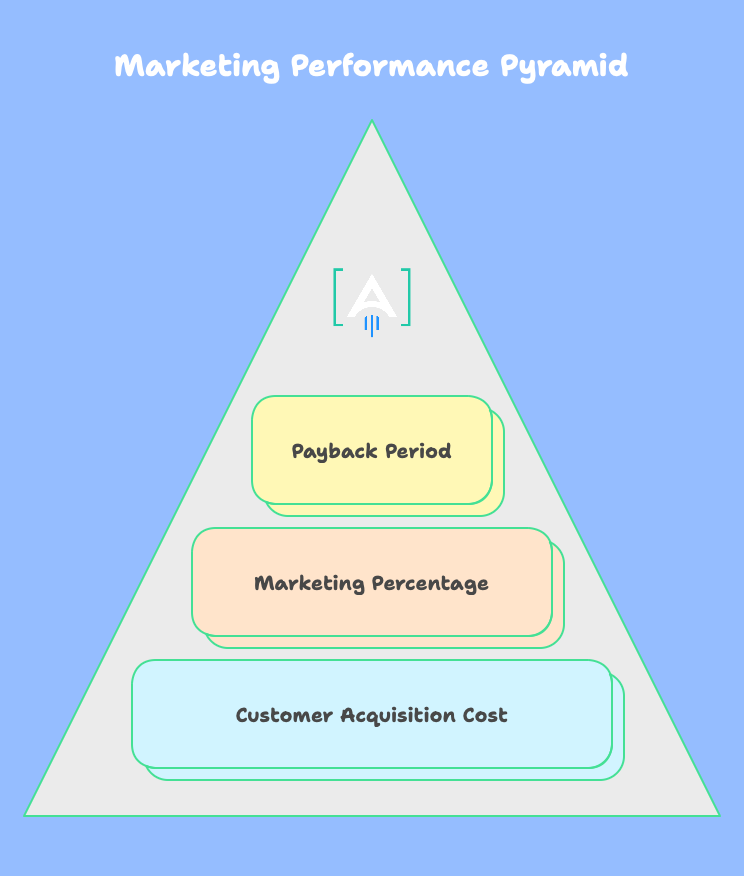
Customer Acquisition Cost (CAC)
CAC shows exactly what you pay to acquire each new customer. Calculate it by adding all sales and marketing costs; salaries, advertising, software, overhead, then divide by the new customers acquired.
Why CAC Matters:
- Reveals marketing efficiency trends
- Compares performance across channels and campaigns
- Helps optimize budget allocation and reduce wasted spend
- Simple to calculate and understand
- Directly impacts profitability
Companies using HubSpot’s marketing platform see an ROI of $5.10 for every dollar spent, providing a clear benchmark for evaluating performance.
Marketing Percentage Of Customer Acquisitions
This metric shows what percentage of new customers originated from marketing efforts. Track all new customers in a period and identify how many started with marketing-generated leads.
Typical Ranges By Business Model:
- Outside sales with cold calling: 20-40%
- Inside sales with lead generation: 40-80%
- Digital-first businesses: 60-90%
Lower percentages suggest marketing isn’t pulling its weight. Higher percentages indicate a strong marketing contribution to growth.
Payback Period
The payback period shows how many months it takes to recover your customer acquisition costs. Divide CAC by margin-adjusted monthly revenue from average new customers.
Target payback periods under 12 months for subscription businesses. Longer payback periods strain cash flow and limit growth velocity.
The CEO’s Performance Dashboard
Create a simple one-page dashboard that answers your core questions without overwhelming detail.
Essential Dashboard Components
Revenue Metrics:
- Marketing-sourced revenue
- Marketing-influenced revenue
- Revenue growth rate
Efficiency Metrics:
- Customer acquisition cost
- Payback period
- Marketing ROI
Volume Metrics:
- New leads generated
- Sales-qualified leads
- Customers acquired
Update monthly. Track trends over quarters, not weeks. Marketing results compound over time.
Questions To Ask Your Marketing Team
The right questions expose performance issues and keep teams accountable without requiring technical expertise.
Strategic Alignment Questions
Start with strategy before diving into tactics or metrics.
Core Strategy Questions:
- Which customer segments deliver the best unit economics?
- What is our competitive differentiation in the market?
- How does marketing strategy support our growth objectives?
- What would happen to revenue if we cut the marketing budget by 30%?
Weak answers to these questions indicate strategy problems that no amount of execution can overcome.
Accountability Questions
Hold marketing teams accountable for business outcomes, not activity levels.
Performance Questions:
- What percentage of the pipeline does marketing source?
- How has customer acquisition cost trended over the past six months?
- Which channels deliver positive ROI and which don’t?
- What would you change if this were your money?
87% of marketers using modern marketing platforms felt their strategies were effective, suggesting tools and accountability systems matter for performance.
Resource Allocation Questions
Verify that resources flow to activities delivering results.
Budget Questions:
- How is our marketing budget distributed across channels?
- Which channels would you increase or decrease, and why?
- Are we investing in capabilities that matter or nice-to-haves?
- How does our marketing spend compare to similar companies?
Marketing teams should provide a clear rationale for resource decisions backed by performance data.
Red Flags That Demand CEO Attention
Certain warning signs indicate serious problems requiring immediate intervention.
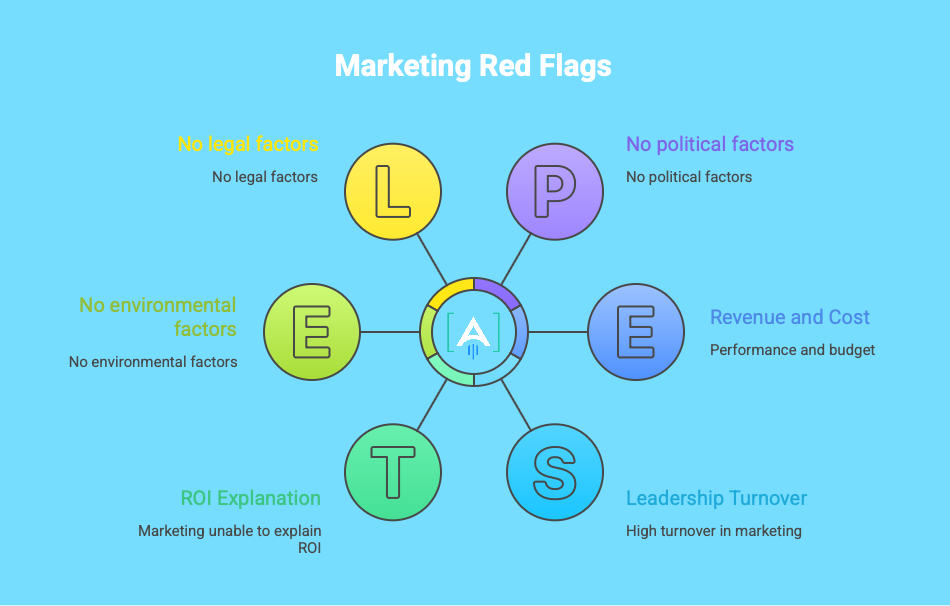
Performance Red Flags
Watch for patterns suggesting underperformance:
Critical Warning Signs:
- CAC is rising faster than average revenue per customer
- Marketing is unable to explain the ROI calculations.
- Excessive focus on vanity metrics versus business outcomes
- Consistent failure to hit pipeline or revenue targets
- High turnover in marketing leadership roles
These issues rarely resolve themselves. Address them directly and quickly.
Strategic Red Flags
Some problems stem from strategy rather than execution:
Strategy Problems:
- Marketing strategy disconnected from business objectives.
- Unclear target customer definition
- No articulated competitive differentiation
- Budget allocated by historical precedent versus performance
- Marketing is viewed as a cost center instead of a growth driver.
Strategy issues require CEO-level intervention to resolve.
Evaluating Agency Partnerships
Many CEOs work with growth marketing agencies for specialized expertise. Apply the same performance standards to external partners.
Agency Performance Standards
Hold agencies accountable for outcomes, not activity reports.
Agency Evaluation Criteria:
- Clear connection between agency work and business results
- Transparent reporting on core metrics
- Regular strategic recommendations beyond task execution
- Reasonable cost relative to value delivered
- Proactive identification of opportunities and risks
Great agencies act as partners focused on your success. Poor agencies complete assigned tasks without strategic thinking.
When To Change Agency Relationships
Assess whether your agency relationship delivers value or continues from inertia.
Reasons To Reevaluate:
- Results declining over multiple quarters
- Agency unable to explain strategy behind tactics
- No proactive recommendations or strategic input
- Communication breakdowns or responsiveness issues
- Better options are available in the market.
Change agency partners when relationships stop delivering value, not when you hit temporary performance dips.
Common CEO Mistakes In Marketing Evaluation
Avoid these frequent errors that undermine effective oversight.
Mistake 1: Focusing On Tactics Instead Of Outcomes
CEOs shouldn’t care whether marketing uses email, social media, or carrier pigeons. Focus on whether marketing drives customer acquisition at a reasonable cost.
Mistake 2: Expecting Immediate Results
Marketing investments typically require 3-6 months before delivering meaningful results. Constant strategy changes prevent any approach from succeeding.
Mistake 3: Comparing Activity To Results
More emails sent, more ads running, more content published—these activity metrics don’t indicate performance. Judge marketing by customer acquisition, not busyness.
Mistake 4: Accepting Vague Answers
When marketing teams can’t clearly explain performance, strategy, or decisions, that’s a problem. Insist on clear, specific answers to direct questions.
Making Marketing Investment Decisions
Use this framework to evaluate whether marketing deserves more investment, needs changes, or should be reduced.
Increase Investment When
Marketing has earned additional resources when:
- CAC declining or stable while growth accelerates
- Clear ROI demonstrated on current spend.
- The addressable market is still large relative to the current penetration.
- Marketing sourcing is increasing the percentage of customers.
- Competitive position strengthening
Pour fuel on fires that are already burning.
Change Approach When
Marketing needs a strategic adjustment when:
- Results are declining despite consistent investment.
- CAC rising without corresponding revenue increases
- Strategy disconnected from business objectives
- Leadership is unable to articulate a clear path forward.
- Better alternatives are available in the market.
Don’t throw good money after bad. Fix strategy before adding budget.
Reduce Investment When
Scale back marketing when:
- Consistent failure to demonstrate positive ROI
- Market saturation limits growth potential.
- Unit economics don’t support current CAC levels.
- Other growth channels are showing better returns.
- Business priorities are shifting away from customer acquisition.
Sometimes the best marketing decision is reallocating resources to more productive areas.
Conclusion: Clarity Over Complexity
You don’t need to be a data expert or spend hours staring at dashboards to know how your marketing is performing. Focusing on three key metrics can give you more insight than most CEOs get:
The Essential Three:
- Trends in customer acquisition costs
- The share of new customers driven by marketing
- The time it takes to recover the cost of acquiring a customer
Marketing results should always connect to real business outcomes. Teams that bring in customers efficiently and show a clear return on investment earn continued support. Teams that cannot explain their approach or show improving results may need guidance.
Working with a growth-focused partner like Azarian Growth Agency can make this process easier. They help businesses turn marketing activities into measurable outcomes, showing clearly how each effort impacts customer acquisition, revenue, and overall growth. By focusing on what matters most, they provide clarity without adding complexity.
Stop getting lost in data. Focus on the metrics that actually drive results.
Start getting clear answers from experts who speak your language and deliver measurable results you can actually trust.

